
Trying my hand at some film + fiction writing, I’ve decided to start a series where I watch an old Whodunit and discuss it in a newsletter. Hence, this newsletter.

First up is the Peter Ustinov-as-Poirot film Death on the Nile from 1978. A blessed change of makeup from the Albert Finney Murder on the Orient Express (a characterization I find physically repulsive), this is an interesting exploration on how to deliver classic-era sleuthing to the screen, roughly 44 years after the original novel was published.
Getting down to what matters: it’s pretty good. But I, as you can imagine, have thoughts.
I’ve already seen the Branagh version of the same book, and, without a doubt, this one is better. Of course, we were not as privy to the private actions and political opinions of stars from yesteryear as we are today, but the creep-to-human ratio of the 1978 version is certainly lower than the 2022 version, which somehow managed to cast Armie Hammer, Russell Brand, the kinda-TERFy Dawn French and Jennifer Saunders, *and* Gal Godot.
We are first exposed to the story of an unfortunate jilting– Jackie (Mia Farrow, miscast here as she is in almost everything, but perhaps that’s because Mia Farrow is not a good actress) is excited to introduce her fiancé Simon (Simon McCorkindale, the poor man’s Michael York) to her best friend Linnet (Lois Chiles, about whom I am ambivalent) and ask Linnet to hire Simon to be her estate manager. Quelle surprise, Linnet and Simon marry and Jackie is pissed as all get-out. Linnet and Simon honeymoon to Egypt, but Jackie is following them like a beaten spaniel. It’s gross.
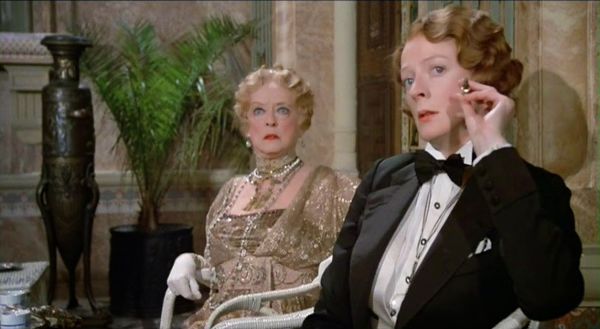
Several other abusers and ne’er-do-wells are on the same package vacation from hell, and they are: a crotchety old jewel thief played by Bette Davis, an extremely butch Maggie Smith as her maid, George Kennedy who can’t do a British accent, Jane Birkin who remains French, Angela Lansbury doing her best Mrs. Lovett as the horny ol’ drunk Salome Otterborne, and a few other people who are of absolutely no consequence.
Poirot and Colonel Race (David Niven, whom I adore) are also there to join the steamship vacation up the Nile. Race (another recurring character from Agatha Christie novels) is on the boat in an official capacity to suss out whether George Kennedy’s character is trying to embezzle money from Linnet. (He is.) Linnet wakes up dead one night and Poirot has to figure out who on the ship did her in. In an interesting twist of British racism, an Egyptian deckhand is never suspected of having murdered the rich white woman. Perhaps that is because Dame Aggie is *so* racist she believes them incapable, and suspecting one brown man of murder would be like suspecting an armchair of grand larceny. But this is my own observation.
From the very beginning, the culprits are obvious, and the film (both versions, really) deviates slightly from a whodunit to a howcatch’em, because no one else’s motives are really strong enough to warrant murder aside from who gets accused in the big reveal. But I digress.
The oddest thing about this version of Death on the Nile from a modern perspective is just how much lead up time there is until the murder. A full hour of runtime goes by before Linnet gets blasted. A consistent note I get while writing mysteries is that the death has to happen earlier and earlier in the book. I think, nowadays, if the murder could happen in the first sentence, that would be ideal for both editors and readers. In Viviana Valentine and the Ticking Clock, I got the main murder into the first chapter. The other books? I had to cull pages and pages of story to get to the crime faster. And still there are grumps about slow pace on Goodreads. Whatcha gonna do.
The brilliant Dorothy L. Sayers once said, “There certainly does seem a possibility that the detective story will come to an end, simply because the public will have learnt all the tricks.”
(She also once said, “Time and trouble will tame an advanced young woman, but an advanced old woman is uncontrollable by any earthly force” but that’s probably a quote for another essay.)
Needing the mystery to start within the first fifteen minutes of a film may just be the easiest tool to hamstring the audience of a sleuthing movie and deliver a satisfactory reveal in the final fifteen minutes. Murder is a complicated sin to mull over in fiction, but the reality is, there are only so many motivating forces behind committing the atrocity. Revealing every character’s motive prior to the murder may make modern audiences less surprised when our sleuth finally reveals who, in fact, has “dunit.”
Certainly, one thing that makes for easier whodunit pacing and scripting now is an audience’s understanding of flashbacks/non-linear storytelling. In the reveal of both Knives Out and The Glass Onion, Rian Johnson makes excellent use of flashbacks to have Benoit Blanc reveal his train of thought to arrive at the killer. The edits are quicker and snappier than they are in Death on the Nile, with information given in staccato, rapid-fire cuts. While Ustinov is delivering his monologue to the collected shipmates, the flashbacks are long, slow, and deliberate. The characters move as if in exaggerated pantomime. There’s no urgency to a murder that is supposedly committed in a truncated period of just a few minutes, under the duress of possibly being caught. Almost nothing about the film seems urgent. And it’s something that modern audiences just don’t have the patience for.
Another aspect of, say, Glass Onion that is different to this version of Death on the Nile is that in Glass Onion, the edit cuts back to scenes viewers have already experienced. Benoit Blanc reveals who killed a party attendee by making us “recall” (and by that, I mean re-watch) scenes we have already seen. Repeat watching (as well as our own rewinding and fast-forwarding, because Glass Onion was experienced by most of us on our home televisions) shows us that the “remembered” moments actually differ slightly– a glass handoff versus a glass pickup– but the purpose is to drive home deftness, sleight-of-hand, and a peculiar, delicate cruelty displayed by our murderer. The flashbacks in Death on the Nile are not nearly as delicate or detail-oriented. I do think that modern audiences expect this level of attention to detail– the industry of the YouTube trash-talking, scrutinizing, deep dive depends on filmmakers not having continuity or script supervisors. And certainly we want to keep asshole YouTubers in business! Don’t we?
Now that whodunits are seeing a slight uptick in popularity (I have theories on why that is, which I’ll expand upon in future newsletters), I wonder what kind of genre conventions we will do away with. Death on the Nile definitely uses flashback depictions of the crime in a way that, say, the 1934 Thin Man movie didn’t. Are audiences getting savvier? Can we continue to pull wool over people’s eyes as efficiently as we did in the 1970s, or must we all have the rapt attention to detail that Johnson has demanded of us in the new Benoit Blanc mysteries? I don’t currently have a Netflix account, but Wake Up, Dead Man is going to be a must-watch for me ASAP because I just need to know what kind of world we’re working in right now. Easter Egg culture makes me want to die a little bit, but I’ll be damned if it didn’t make for better mystery movies!



 msemilyedwards.com
Leave a comment