

Set five years before LA Confidential and premiering two years before it at the Toronto International Film Festival, Devil in a Blue Dress should be considered a foundational, post-War LA detective film. But it isn’t.
Why didn’t this win Oscars? Why did it bomb at the box office? Why is there only one Easy Rawlins onscreen adaptation? Why on God’s green planet did we get two seasons of a bastardized Perry Mason knockoff that turned a gentleman sleuth like Perry into a hardboiled detective when Easy goddamn Rawlins was RIGHT HERE THE WHOLE TIME?
JK, we all know why.
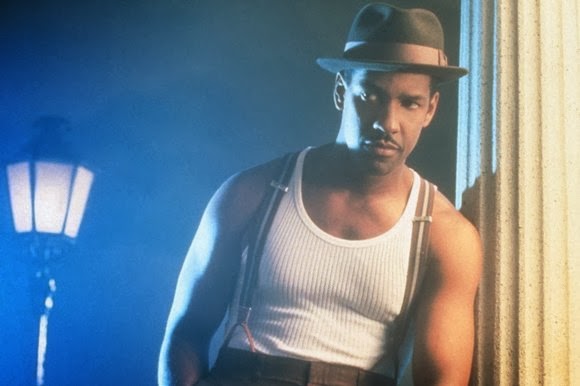
Based on the first book from Walter Mosley’s seventeen-books-and-counting Easy Rawlins series, Devil in a Blue Dress was written and directed by Carl Franklin, starring Denzel Washington as Easy, Don Cheadle as Easy’s friend Mouse, Jennifer Beals as the titular woman in a blue dress, and Tom Sizemore as a heavy named DeWitt Albright. In the film, Easy loses his job at a factory and is approached at a friend’s bar and offered a way to make some quick cash– just find a girl who calls herself Daphne. This leads him down a road of violence and racial tensions in post-War LA that are, well, exactly the same as violence and racial tensions in LA 80 years later.
Literarily speaking, the private investigator occupies the same space as the chivalric white knight or a knight-errant. These are people who are untethered (or unburdened by familial obligations more complicated than “honor”) who can perform tasks for glory and defeat un-Christian evil. The knight may be tempted to stray from his course– usually by women (who are frequently witches), sometimes by the promise of dirty money or valuables– but in the end, he will likely give up his own earthly pleasures or rapid advancement in order to bring the culprit of the original sin to order.

[SPOILERS AHEAD:] In one way, Easy Rawlins fits this narrative without missing a step. He lives by himself but meets at the table/bar with various friends and long-term acquaintances. Brought into action by the owner of his favorite bar, Joppy, he’s called into service to find a maiden faire– okay, a white lady who likes Black culture a little bit too much for everyone’s comfort. Easy’s gotta return her to her castle (her extremely rich, white boyfriend who is running for mayor), and then be on his merry way, heaped with rewards. Christian morals are being broken (another candidate for mayor is a pedophile and our maiden has proof), but she also is dallying in some kind of witchcraft, a.k.a., she’s a mixed-race woman passing for white but also trying to exist in Black spaces, and neither side is happy with the way she’s been shapeshifting and destroying boundaries.
Like any private investigator and knight errant, Easy has been tasked with restoring order. Unlike Hercule Poirot or Sam Spade or Philip Marlowe, that order ultimately requires his own subjugation, as a Black man in a heavily segregated society.
Franklin excels in the art of adaptation, and by that, I do mean the streamlining and simplification of a novel for screen. He’s cut some characters, straightened out some relationships, and trimmed some of the politics of Easy’s background as a Black soldier in World War II and what it means to be “back.” Onscreen, Easy doesn’t wrestle with what it means to have been a soldier “fighting for freedom” (a phrase he uses in the book), only to be back in a place where he can easily be arrested and beaten for being a Black man in any place at any time, let alone the wrong place at the wrong time.
Easy– at least on screen– readily accepts his reality in a way that many of his white, Private Investigator counterparts do not. Easy sets down roots. He is a proud homeowner in a world where that is unusual for Black men, and his community is proud of him. He is a king of a nice little two bedroom, one bath bungalow castle. Could you imagine Humphrey Bogart as Philip Marlowe attending to his petunias, as Easy does onscreen? Of course not. In a way, this movie has very little of the noir PTSD that we associate with detective films because the traumatic stress of being Black in America is something Easy Rawlins knows he’ll never be “post.” It’s just trauma. It’s just stress. Can it be “disorder” if the closest thing to “order” a Black man in 1948 will experience is mowing his own lawn?
But that is not to say that Easy Rawlins does not experience any normalcy or happiness, or, dare I say it, Black Joy. One thing that is quite interesting to point out about Easy is that for this entire film and the majority of his book series, Easy is not a licensed private investigator. He doesn’t hang up a shingle, he doesn’t get an office with his name on the door. Easy refers to his trade as doing people “favors.” He is not in someone’s employ. They just say thanks for the favor with money. Easy has friends, Easy flirts, Easy has one sex scene in this movie (and one that was cut). Easy’s got his house, Easy’s got his car, Easy has his community. Easy doesn’t have a boss. He doesn’t have to do anything for anybody if he doesn’t want to. It is alluded to with a line at the end of the film adaptation, but Walter Moseley gives Easy Rawlins a passive income– he buys some more property and becomes a landlord. Easy is, again, king of his own castle and all his lands. Knight-errant, schnight-schnerant.
In her article “Power and Knowledge in Walter Moseley’s Devil in a Blue Dress” in the 2001 issue of the African American Review, Marilyn C. Wesley points out a key power imbalance between white American private investigators, and Easy Rawlins:
“The essence of both the classic and hard-boiled detective story is the pursuit of knowledge, and the source of that knowledge is the violence that threatens civil order. The different between the white hard-boiled detective and Mosley’s black detective is to be found in the ends which that knowledge serves. Despite his cynicism, a character like Raymond Chandler’s Philip Marlowe is a servant of the dominant system of law and order. But Mosley’s Easy Rawlins needs to learn how the operation of that system in the post-war era affects the power of the black man to survive and prosper.”
I wouldn’t go so far as to say that authors of classic P.I. novels where all hoo-rah American jingoists like we associate with the phrase “law and order” twenty-four years after Wesley wrote the aforementioned article– Dashiell Hammett was investigated by HUAC and was a card-carrying communist, of course, and there is plenty of scholarship on Raymond Chandler being closeted- but Wesley is obviously correct in asserting that there would be no real incentive for Marlowe and his ilk to question white supremacy; what usually ends up happening is a sort of Bernie Sanders-type political statement where the rich white guys were the bad guys all along and Marlowe, et. al., have no issue throwing them into the maws of justice because Marlowe, et. al., are not, themselves, rich guys. Most of those books and short stories are dripping in blatant white supremacy and racial epithets are recklessly hurled at peripheral characters, but the “classics” are stories of justice exacted by middle class white men for middle class white men. In a 2013 interview with the LA Times, Moseley admits, “Easy in many ways is the opposite of Philip Marlowe.”
I’m sad that the interviewer didn’t ask Moseley to elaborate on that thought. The article brings that thought around immediately to Mosley’s then-most recent book, in which Easy helps his assistant become a private investigator herself (not that I know anything about books with that particular plot point) and does not go any further into a Black author’s deliberate decision to write a character antithetical to the most famous LA-based literary detective. As much as city planners have tried to hide it– both in the ’40s and now– LA is not a white city. There’s no reason to pretend that justice in our town comes in the form of Humphrey Bogart, Robert Mitchum, or even Elliot Gould. Justice in our town can come in the form of Easy Rawlins.
Which leads me to one of my original questions: why the HELL has this series not been brought to the screen again? A handful of production companies have secured the rights to Easy Rawlins over the decades, and last reported, they’re in the mitts of Amblin TV, Steven Spielberg’s company. In the novel, Easy is 28 (Denzel was 40 at time of filming). Someone means to tell me there is not an actor out there between the ages of 25 and 40 who could star in a prestige TV show about one of the most dynamic periods of time in one of America’s most populous cities? Get outta here.
We should all regret that this did not turn into a long-running film series. Washington is as good in this as he is in anything, Don Cheadle is genuinely frightening as Mouse, a longtime friend called in from Easy’s hometown of Houston to help on the case. Mouse is trigger-happy and suave, completely free from the strictures of conscience and the perfect foil to Easy’s world-weary wisdom. The setting of 1948 Los Angeles is vivid– and let me tell you as someone who has lived here for about twenty years, I recognized many of the buildings that they slip in and out of. Everything about the world of Easy Rawlins is real.
In our current media environment of “IP and only IP,” one would assume that a seventeen-book series was enough proof that audiences hungered for Easy Rawlins.

 msemilyedwards.com
Leave a comment