

I’ll bet you’re surprised to see the year 1978 in those parenthesis. Usually, when we talk about Raymond Chandler’s The Big Sleep onscreen, we’re discussing the 1946 version with Humphrey Bogart as Philip Marlowe. But, unfortunately, that movie is terrible.
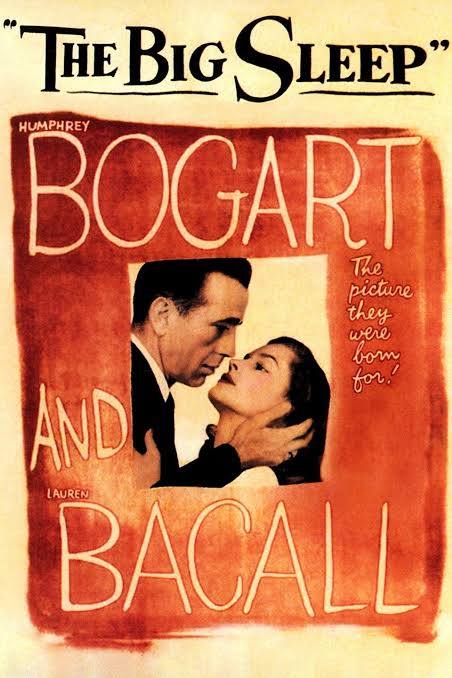
Before all the “serious” cinephiles kill me: the movie is great for vibes. It practically defined how you were supposed to feel while, and after, watching a detective movie. If you want to see Bogey be all noir-y and snide and have babes chuck themselves at him while he solves a crime, watch it. But if you expect movies to do silly things like “have a plot with a logical conclusion” and “be comprehensible on the first watch,” then, well, you’re shit out of luck. The Bogey Big Sleep doesn’t do that. There are reddit posts that say because the movie is a mystery it doesn’t have to make sense, but those posts are, and I mean this with my whole body, stupid. Mysteries have to make sense. Mysteries are literally about creating order. We’ve been over this, class.
The 1946 version of The Big Sleep is hamstrung by the Hays Production Code.
Humphrey Bogart, Lauren Bacall, director Howard Hawks, and writers William Faulkner (yes, that William Faulkner), Jules Furthman, and Leigh Brackett (a lady!) are doing their absolute utmost to bring every seedy detail of the original novel to screen, but because of the strict self-governance of the film industry, they weren’t allowed to do it. Published in 1939 and set a few years earlier, it was (relatively) fine for Chandler to write a book about pornographers sexually assaulting and blackmailing rich women with naked photos… but you couldn’t do that on film seven years later. Not if you wanted that film to be distributed in America. The 1946 adaptation sucks a little bit because many of the plot points removed were load-bearing plot points. We do kinda care that Carmen has some salacious pics floatin’ around, but without the added threat of the photos being reproduced and sold as a product to all the perverts of the greater LA area, the mystery is neutered and somewhat toothless.
So I set out to see if the other version, the one with Robert Mitchum, had its bite.

The good news is, the latter version of The Big Sleep makes sense. It’s still convoluted (blackmail meets drug dealing meets maybe-illegal gambling meets murder meets illicit pornography meets gangsters meets gun running meets a few other crimes I probably don’t remember), but if you pay attention, the dominoes line up and fall down and it’s rather satisfactory. So A+ to Mitchum and writer/director Michael Winner for all of that.
But it’s still… not quite right.
Robert Mitchum is the only person to ever play Philip Marlowe onscreen more than once.
And most people complain about that, because Philip Marlowe is in his early- to mid-30s in all of his books. The character is about six feet tall, brown hair, brown eyes, and just a regular dude, which helps when one’s job is to spy on people, hopefully without them noticing or shooting you. Mitchum is, in both of his Marlowe films, about sixty– 58 in Farewell, My Lovely and 61 in The Big Sleep. But it’s a 1970s sixty. Which is to say, a really, really hard sixty. You know who is also sixty? Sandra Bullock (61). Steve Carrell (63). Colin Firth (65).
Thank god we learned about sunscreen.
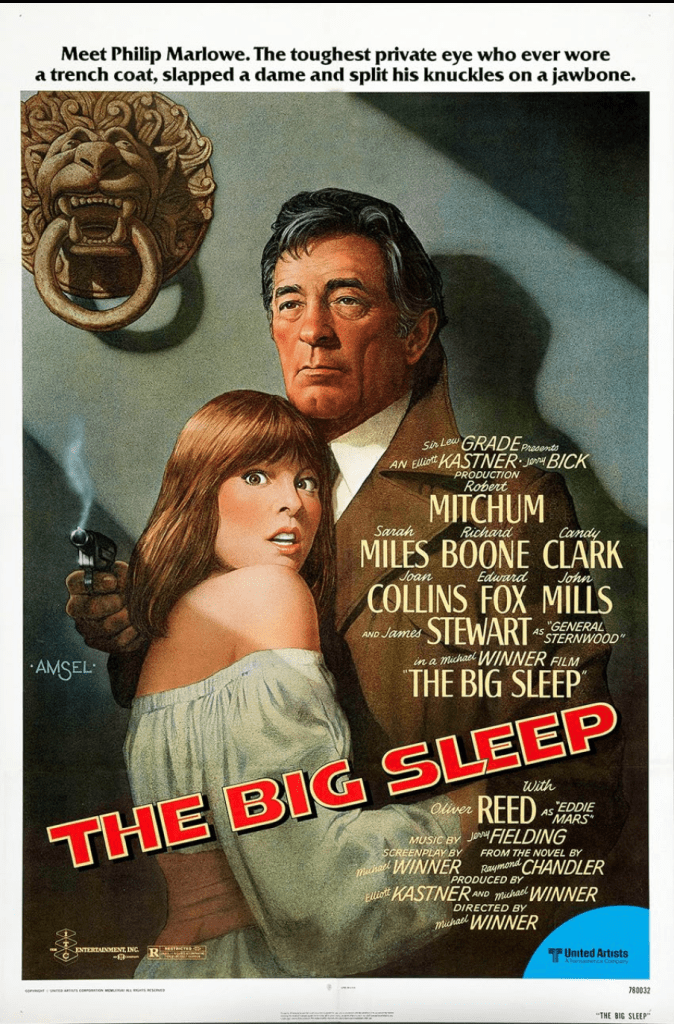
I am slightly biased because I. Love. Robert. Mitchum. You won’t hear me swoon over things like this all that often but I will say something right now that betrays a lot of my public persona: Robert Mitchum was a goddamn man. In the way that other people go “Oooh, Charleton Heston” or “Look at Clint Eastwood,” that’s how I feel about Robert Mitchum. I do not agree with any of his personal politics. But if you wanted A Real Man™️ onscreen, I would say Robert Mitchum fit that bill to a T. But, like, in his prime. I still don’t think Mitchum would have been the correct casting in his 1950s heyday– my friend Danny Bowes suggested Dana Andrews over on Bluesky, and I think that’s perfect mental casting. But in the 1970s? While Denzel Washington today, at 70, could probably still play Easy Rawlins in Devil in a Blue Dress, 61 year old Robert Mitchum could not convincingly play a Private Investigator at his physical and sexual pinnacle. I’m sorry, Robert. You look like a grandpa, especially in those polyester suits.
But what about Los Angeles, the other main character in a Marlowe story?
A slight hiccup with the 1978 version of The Big Sleep is that it was financed by a British movie company called ITC Films and they– inexplicably– moved the most famous Los Angeles-based detective in the history of mystery… to London.
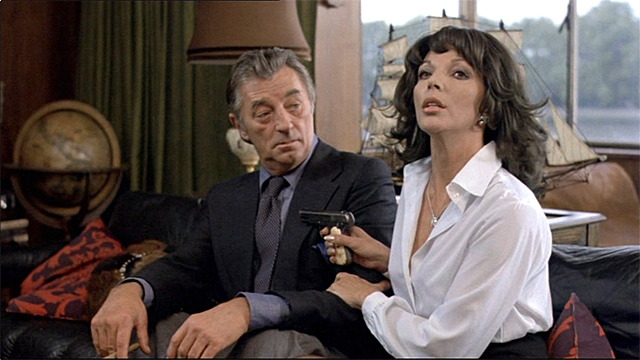
Now, I know how movies are made and I’m 100% sure that this was entirely for financing reasons. The supporting cast in the movie runs the gamut from fun (like Joan Collins!) to extremely beyond words creepy (Sarah Miles and Candy Clark as the Sternwood daughters are both utterly demented and gross). James Stewart is here as the disabled father, General Sternwood, who is American and had ::waves:: reasons for moving to Britain after the war (those reasons are never detailed). We are given no reason for Philip Marlowe– also American– to be in London. Everyone else on screen is from the UK and meshes with the change of locale. Interestingly, Rusty Regan, the missing husband of the elder Sternwood daughter, has been changed from being a 1930s bootlegger to a 1970s IRA member. It’s fine. That’s all fine. Details like that ensure the new setting makes some sort of sense.
But part of me wonders why they didn’t just try to pass off England as LA. Sure, even the brightest summer day in ol’ Blightey is only as sunny as a SoCal January, but that doesn’t really matter. You can’t catch a glimpse of an errant palm tree, but who honestly cares. Manor houses come with more acreage than even the biggest Beverly Hills mansion these days, but who really needs to know that. Philip Marlowe is of Los Angeles. He is a private investigator in the freshly tamed Wild West. He is a man who deals with the trials and tribulations of the newly rich, not in the mannered Gilded Age– or in a place where peerage has always been and remains a millstone around society’s neck– but in an age of vice and filth, where anybody can suddenly be somebody. The 1930s in Los Angeles was a decade in which ranches were only just being replaced with highways. Where broke little Ruby Stevens from Brooklyn could grow up and become Barbara Stanwyck, femme fatale. Philip Marlowe is about creating order in a place where order has not yet been fully defined.

Perhaps British filmmakers of the 1970s thought that contemporary Los Angeles was too debaucherous a setting.
The ITC producers could have looked to Robert Altman’s Philip Marlowe movie, The Long Goodbye made in 1973, for a better idea of how to pull off a film functioning in an LA ’70s, but that movie changes the ending of its source novel and requires Marlowe (Elliot Gould) to travel to Mexico, the American conceit of a lawless place, in order to finish a case that started in Malibu. LA in the 1970s was a notorious hotbed of pornography and sex work, so maybe the British filmmakers of The Big Sleep thought it wouldn’t make much sense for a girl about town to be blackmailed by being in photos with her clothes off. Maybe they thought everyone was doing it back then.
Of course, one key detail from the book was relatively glossed over in the 1978 version, too: Geiger, our glass-eyed smut peddler, is queer and is having sex with the male who works in his shop, Carol (in the film, Karl) Lundgren. If you watch Geiger and Lundgren interact for the forty-five seconds they’re on screen together in the Mitchum movie, maybe you could grasp it– there’s a cheek touch that is a bit too soft to be a slap, but too hard to be a loving pat, and that’s about all the text or subtext we get. (It was also heavily implied, in my opinion, that Stewart’s General had beyond-fatherly-love for his missing IRA member son-in-law, but that isn’t delved into.) Laws governing queer sex were relaxed a bit in Britain in the 1960s, but the character of Lundgren is portrayed as a very young adult, if not even a teenager, and therefore, having sex with him would still be a crime on Geiger’s part, per the laws on the books in 1978. Sodomy laws in California were lifted in 1976, so maybe by 1978, British filmmakers thought everyone in sunny California was having licentious queer sex and the setting needed to be changed to a place more orderly, more undone by the lawlessness of a queer pornographer. If there’s one thing we know about the Brits it’s that they think their “normal” to be the very model of society in general. California is considered– to this day! look at modern American politics!– at its core deviant. Maybe the worldview of anyone not from here is that Los Angeles can never be orderly.
Once again: probably not. It was probably a production money thing and not that deep. But the effect is the same– this is Marlowe out of LA. And Marlowe out of time. And therefore… missing an aspect of Marlowe.
Each one of the films that I’ve discussed in Silver Screen Sleuths has been a film that requires a specific setting– a specific place and time.
And while I would never say it was impossible for a mystery to have its setting changed, I think it is something that has to be done with pointed consideration for a mystery novel. What is considered disorderly changes depending on location and era. Not what is legal or illegal, wrong or right. Plenty of bad people get off scot-free in mysteries. But order– like Joan Collins’s Agnes, Geiger’s front in his pornography store, running off into the night in the Mitchum version, despite being embroiled in three murders– has meaning. She is not the energy behind the enterprise. She’s a pawn to be set up in someone else’s game. It is within the tolerance of what is considered orderly for her to be let go.
Theres much to be said about masculinity and virility in these stories, too, which was brought up earlier in discussion of Mitchum’s age. Of course, I’m sure more than a few of you have so far suffered through at least part of Marlowe, the 2022 outing for the character starring a 70 year old Liam Neeson, but even I don’t have the energy to talk about the film right now. I’ll need plenty of whiskey before I tackle that.
But for right now, what I’ll say is this: if you don’t want to nod off into your own big sleep, try the Mitchum version. He’s no Bogey, but it’s one of the better versions of a Marlowe story from the big screen. Just wait until I talk about The Gay Falcon!
 msemilyedwards.com
Leave a comment