
TW/CW: Child loss
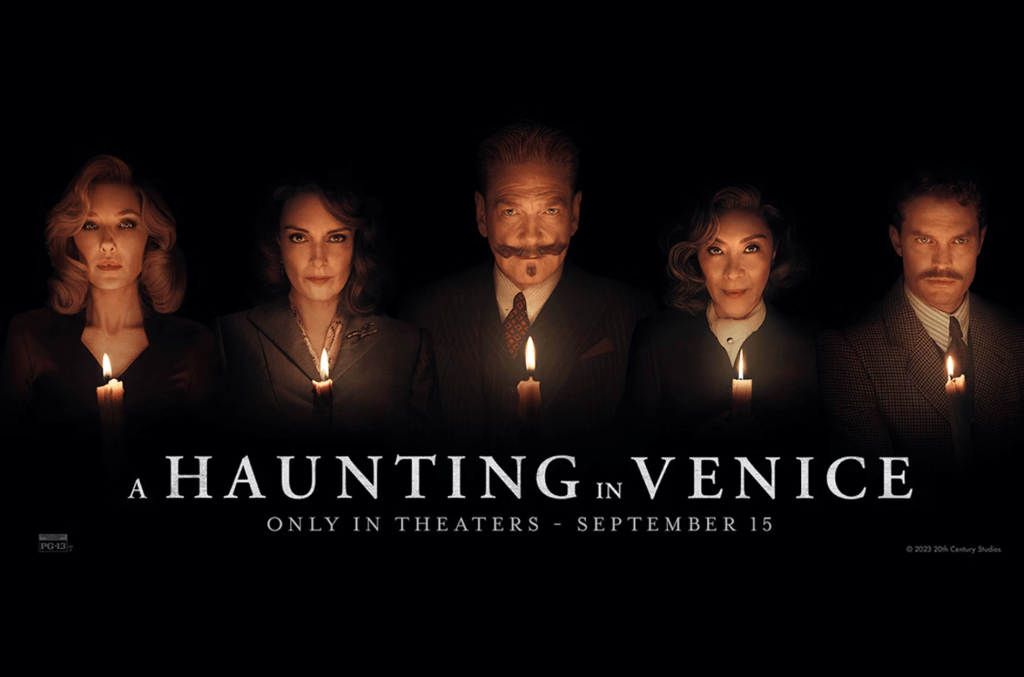
When Kenneth Branaugh’s third foray as Poirot was announced, I was genuinely excited. The first two movies were blemished significantly by casting, and I was relieved to see that the cast of A Haunting in Venice contained no obvious sex pests. Hurrah, hurrah!
The film stars two of my favorite actresses– Kelly Reilly and Tina Fey, proving here that comedians are always good dramatic actors, when it so rare that good dramatic actors are even passable comedians. Fey as Ariadne Oliver– the awkward, kind of messy self-insert for Dame Agatha herself– is inspired casting. It’s nice to see a woman in her 50s not portrayed as an affable dimwit.
I absolutely love the book this movie is “based on.” Hallowe’en Party is– in my opinion– one of Dame Agatha’s most political novels. In it, Poirot is called in by Ariadne Oliver when a young girl is murdered at a Halloween party in a hoity-toity, new-build neighborhood.
It bears little resemblance to the film.
Hallowe’en Party
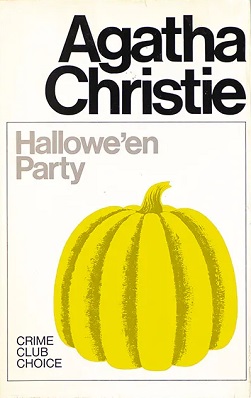
Published in 1969, the novel is something that hovers at a precipice– Christie knows that she’s old (she’s literally 79 the year it is published), she knows that the world is about to spark into something new. Across her career, Christie published 66 detective novels; an informal survey reveals that fewer than ten of the books involve a deceased child, and this one has two murdered kids. The symbolism is impossible to ignore, even if the outcomes are logical for a story that centers around a kids’ holiday party. Agatha-as-Ariadne pours over her thoughts about “kids today”– tweens and teens at the Halloween party in the suburbs break off from the games at times to run off and make out; Joyce, the first child killed, is a loud and obnoxious braggart whom no one seems to like and everyone stops just short of saying they’re happy she’s dead because she was so annoying. Joyce tells a story about having witnessed a murder years ago; everyone is positive she’s making up the story for attention. There’s a sexual thrum to her constant need to lie about experiences.
Ariadne has to talk herself out of badmouthing the dead little girl more than once. Agatha, our author of authors, is admitting to us her own sins: she does not like what the 1960s has done to little girls. Her reflex is to ask what they did to deserve all the things that are done to them. She knows it is wrong. But it is still her reflex.
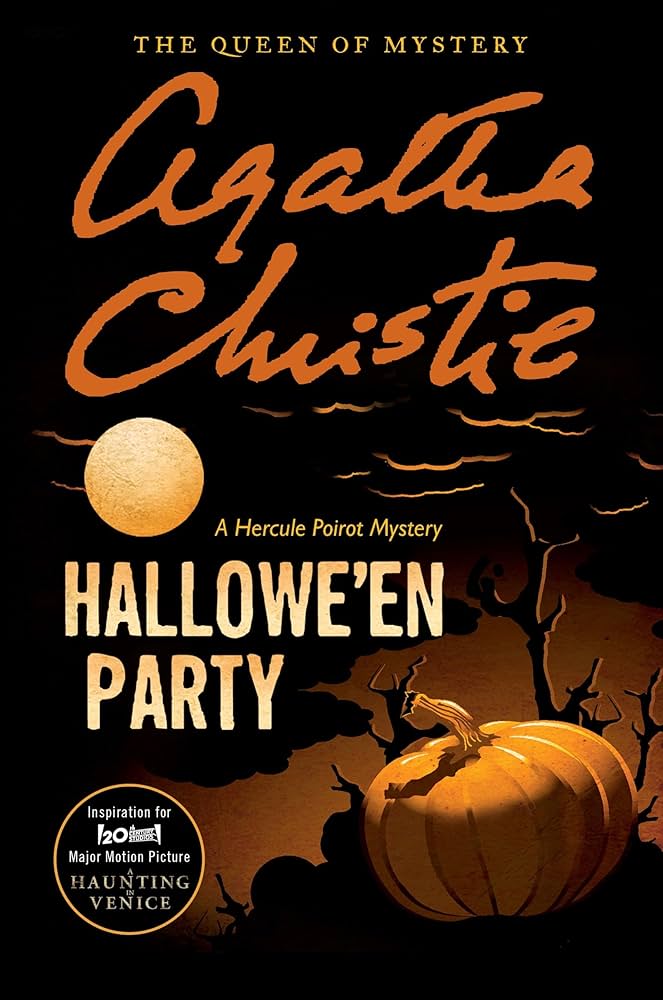
Additionally, the setting of Hallowe’en Party is unique. Our usual maestro of the manor house, Christie seems to be completely uprooted by the the over-churn of the British countryside. Joyce’s death happens in the gilded, fresh-paint-smell liminal space that is a new-build suburb. The houses are large and pristine. The street names are quaint. The roads are sometimes unpaved– multiple times, Poirot has to track through the mud in his too-small patent leather shoes. Christie has shown him to be a man of the moneyed countryside, and a man of the multifaceted city. But Poirot does not know what to do with being a man of a middle space.
[SPOILERS] In the end, two children are murdered– Joyce and her brother, Leopold, both meet damp ends thanks to a woman’s need for independent wealth and a love-affair with a gardener. A man whose entire fascination and obsession is with controlling and manipulating nature, in a garden that was once a rural idyll (there’s that rural idyll again!), but now within a short tromp of a manufactured town with gossiping, horny teens and prevalence of motorcars. Everything in Christie’s old world is spoiled.
A Haunting in Venice
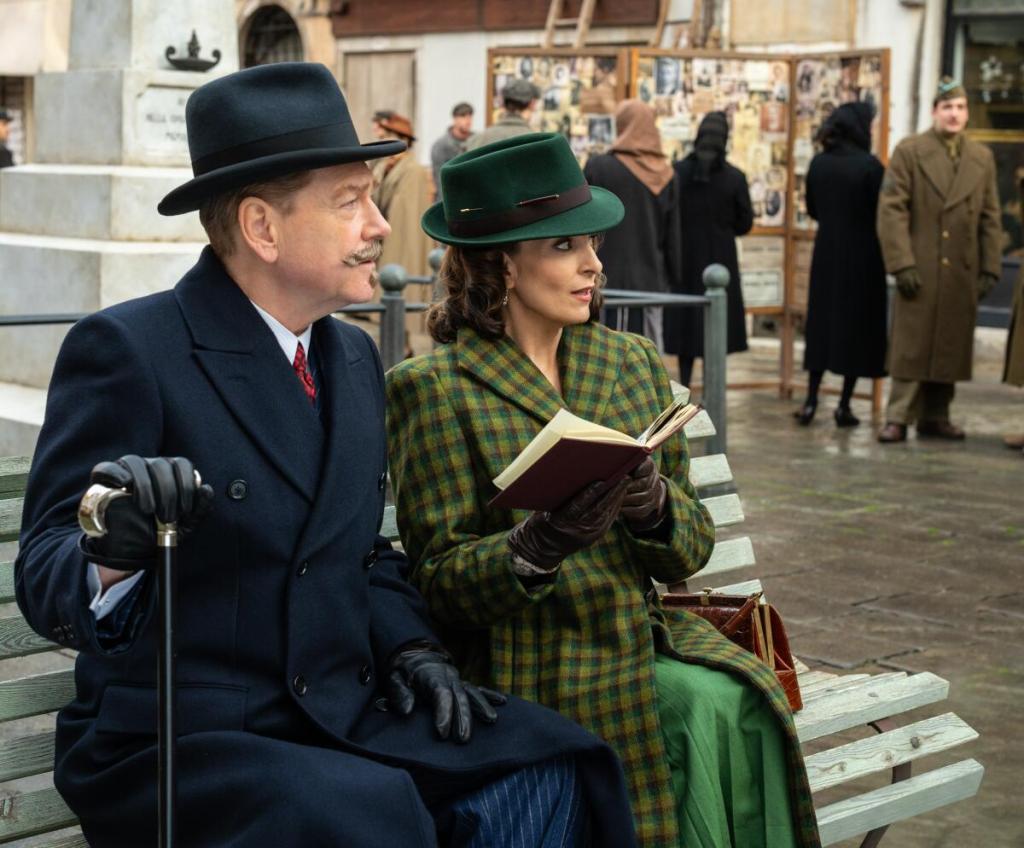
The film begins with a montage of Venice, shot at Dutch angles, and here to remind us everything is off-kilter and the city is sinking. The sky is cloudy and murky, and the effect is stunning. None of the trappings of Hallowe’en Party are here for us in the film adaptation. We are not in the ‘burbs. No one is speaking English. Poirot has a violent, Italian bodyguard– the exact opposite of Hastings. Nothing is cozy or mannered. Joyce Reynolds is no longer a 13 year-old, brassy loudmouth, desperate for any kind of attention. Instead, she’s Michelle Yeoh, a 60+ psychic medium at the center of an elaborate seance put on by a wealthy and lonely opera singer, Rowena Drake (Kelly Reilly).
Interestingly, both aspects of the setting of the story are changed for the adaptation– we’re not in suburban England, we’re in Venice, and the story does not happen in 1969. Instead, it’s 1947 and World War II has just ended. Venice is opulent, but it’s a post-war, forgotten wealth that makes us wonder why anyone is even living there. Is it to feel like it’s the time of doge palaces and Titian? To hide from everything that had transpired in the past decade? Somehow, the bubonic plague is a plot point, as is the PTSD of World War I veterans. I know from writing books set in 1950 that the time period felt much older than we seem to recall. But the movie feels older than even that. It would be impossible to set a haunting murder mystery in 1969, the era of endless TV and The Beatles.
Interestingly, children are central to the storyline of Venice, but instead of one murdered child, we have a whole hospital filled with the ghosts of dead kids. A few kids run through the scenery in the creepiest goddamn costumes ever, but there are no (living) little girls who take up screen time and physical space, and only one minor boy is central to the story, there to be a precocious and unnerving prodigy. If, in Hallowe’en Party, Dame Agatha begs us to ask the question, “What do we do in a modern world, with girls who are not proper?”, A Haunting in Venice forgets the question entirely. It’s a shame, because the book’s central conceit is excellent, but the change is fine for the movie that is being made.
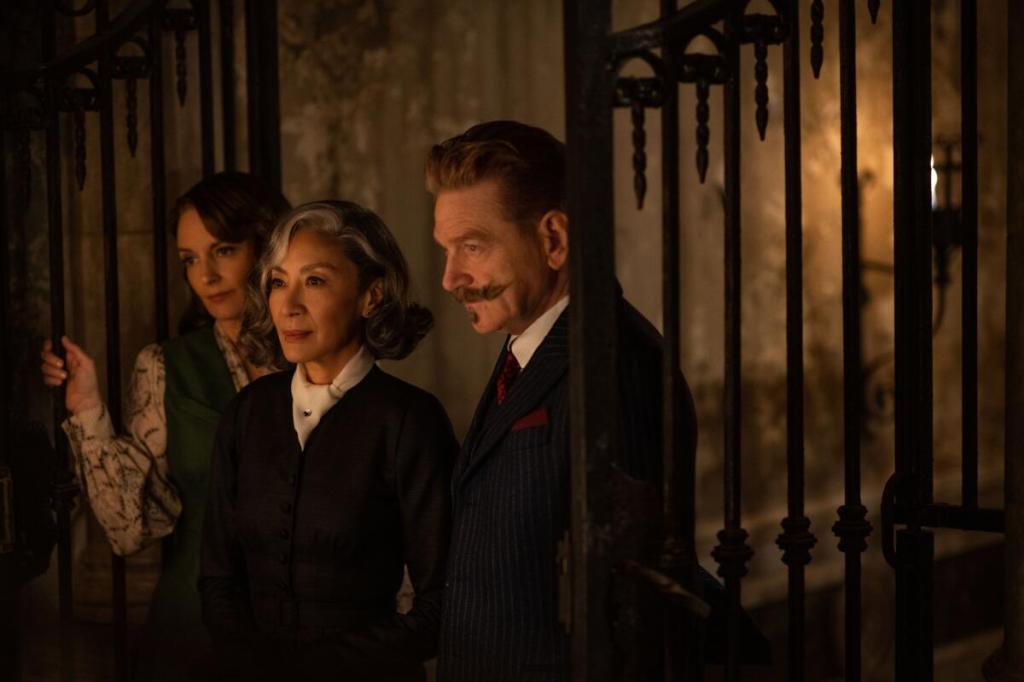
Last week, I wrote a small piece talking about the correlation between the Gothic horror mansion and the country house mystery, using the 1985 film Clue as a framework. Clearly, A Haunting in Venice seeks to blur the line even further between the two genres. The psychic medium who meets her end in the courtyard of a Venetian palazzo is only our first taste of what is otherworldly; the bones of dead children whisper from the basement and a murdered girl appears to us as her soul is avenged. Poirot, a logical sleuth and direct successor to Sherlock Holmes, has very little patience for all of this mumbo jumbo. It works here because Poirot knows that even if, in the unlikely event, ghosts are real, they are not primarily responsible for the dead woman the courtyard, or the attempt on his own life. Ghosts may haunt, but that is a psychological torment. Murder is physical, tangible, solid.
Hercule Poirot: I must tell you, Madam, I have been all my life uncharmed by your kind.
Mrs. Reynolds: My kind?
Hercule Poirot: Opportunists who prey on the vulnerable.
Mrs. Reynolds: You don’t believe in the soul’s endurance after death.
Hercule Poirot: I have lost my faith.
Mrs. Reynolds: How sad for you.
Hercule Poirot: Yes, it is most sad. The truth is sad.
And, really: the truth is sad. When Poirot reveals who has caused so much death and destruction, it’s the saddest possible culprit. Poirot tells us at the beginning: you are going to be haunted. You are going to be sad. Someone has taken advantage of you, the watcher, the vulnerable person who came here with good intentions. We will all leave this story worse. It’s a hard pitch for a big-budget movie.
The movie is atmospheric and enjoyable, if a bit slow and overly-reliant on aesthetics to make the whole thing work.
I enjoy a good locked-mansion mystery and will never complain about something being set in Italy, a culture I still think most American (and British) WASPs don’t quite understand. Poirot is methodical and intelligent and just what you would expect from the characterization and genre. Most of the supporting cast really delivers and Branagh is a good Poirot. I hope he comes back for more, though I don’t know if any of the films have made enough money to greenlight a fourth. It was made on a relatively modest budget of $60million, even though it feels opulent and the casting is notable enough to make headlines. It is a solid chapter in the Poirot canon, though a purist streak in me longs for simpler and less bombastic stories.
As I quoted in the piece on CLUE, “The battle between humanity and unnatural forces of evil (sometimes man-made, sometimes supernatural) within an oppressive, inescapable, and bleak landscape is considered to be the true trademark of a gothic horror novel.” I personally find the battle between humanity and evil to be best told through a non-supernatural lens, but wholeheartedly appreciate Poirot’s little side-step into the spooky. This movie is a treat for Halloween for grown-ups who don’t necessarily love slashers but need something more substantial than children’s games.
A Haunting in Venice is streaming on Disney+.
 msemilyedwards.com
Leave a comment