
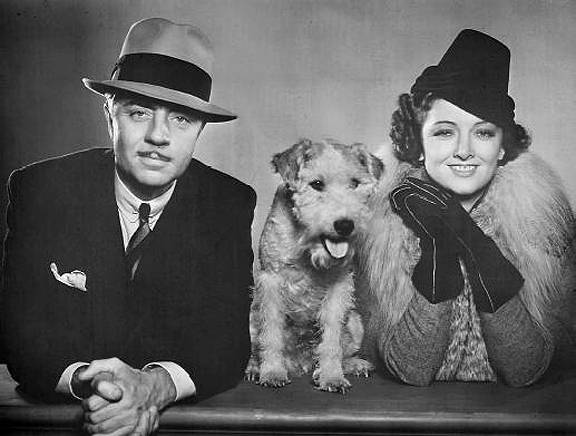
Every year, those of us in the literary sphere (I will generously include myself) are titillated with the list of works suddenly heading into the public domain. A lot of “copywrong” people become suddenly thrilled that they can make Winnie The Pooh slasher films or pornography starring Bertie Wooster or whatever without the threat of lawsuit or royalty payments; the rest of us are just intrigued by the passage of time. This January, it’s time for society to release the spirt of two of the sleuthing world’s greatest characters: Nick and Nora Charles, from Dashiell Hammet’s last, great work, The Thin Man. But lucky for us, the perfect adaptation of the book already exists: the MGM’s adaptation directed by W.S. Van Dyke, starring William Powell and Myrna Loy.
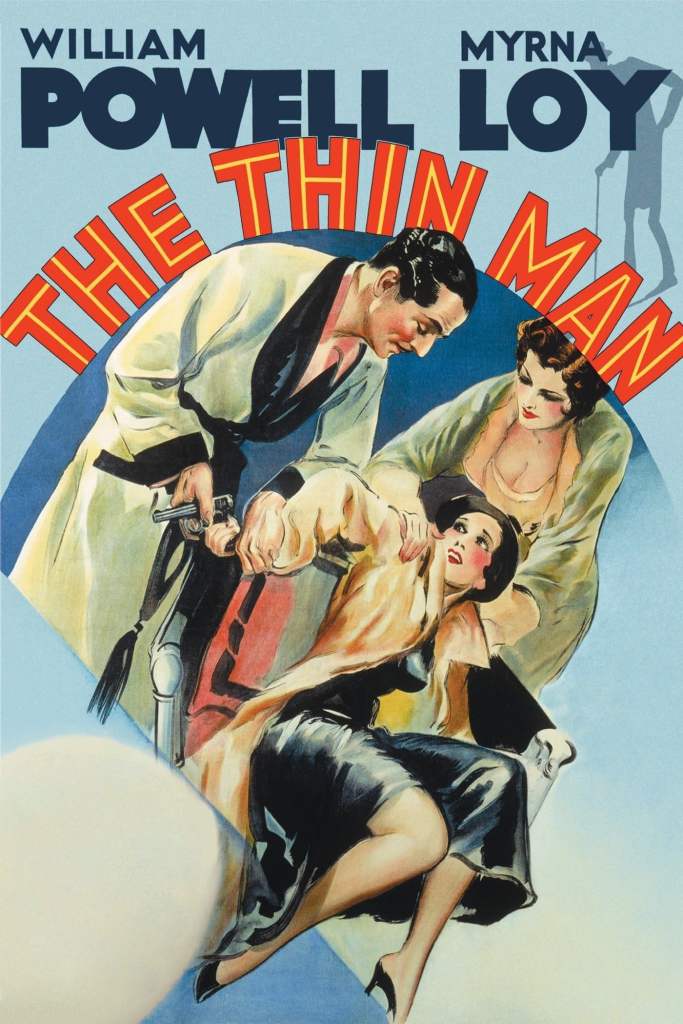
The Thin Man follows the escapades of former Pinkerton detective Nick Charles and his WASP-y, wealthy, and much-younger wife, Nora. While in New York City for Christmas, Nick is asked by Dorothy Wynant– the daughter of a former client, an inventor named Charles Wynant– to find the whereabouts of her missing father. Nick is hesitant to take the case, but Nora wants to see her husband work the detective magic he was famous for in a previous life. Once Nick is implicated in the disappearance, he decides to take the case and clear his name. Part private investigator and part gentleman sleuth, there’s no doubt that Nick Charles will get to the bottom of the disappearance.
“Willaim Powell… by now is a past master in the art of sleuthing,” the New York Times review of the film begins. The Times– like virtually every other paper that took the time to blurb the film– was effusive in its praise for both Powell and the feature at large. “Out of Dashiell Hammett’s popular novel, ‘The Thin Man,’ W. S. Van Dyke, one of Hollywood’s most versatile directors, has made an excellent combination of comedy and excitement.” The piece ends with the glowing assertion that, “Mr. Powell’s performance is even better than his portrayals of Philo Vance in the S. S. Van Dine stories.”
This, I’m sure, was a relief to Powell, who was notoriously negative about his time spent as Vance, the brainchild of Willard Huntington Wright, writing under the pseudonym S.S. Van Dine. In a 1930 issue of Talking Screen, Powell speaks openly of the character he was actively portraying:
“The opportunities of a detective on the screen are too limited. What is his main function? To solve the crime. And how does he do it? By thinking. So we have him standing up and thinking, sitting down and thinking, lying down and thinking, ad nauseam. He is practically the only member of the cast without a chance for dramatic action or outstanding characterization. The interest revolves about him, true enough— but he is like a rock in the center of a whirlpool. ‘ He doesn’t have a chance to act!”
William Powell is one of my favorite actors, and it’s not only because he plays the ultimate Wife Guy in The Thin Man. He’s excellent in My Man Godfrey (opposite his real-life, ex-wife Carole Lombard, with whom he was incredibly friendly), or an affable cad in Libeled Lady. There’s just something genuine about him– which comes across in his respect for his leading lady, Myrna Loy, with whom he made fourteen pictures. That’s one fewer than the number of pictures in which he played a sleuth!
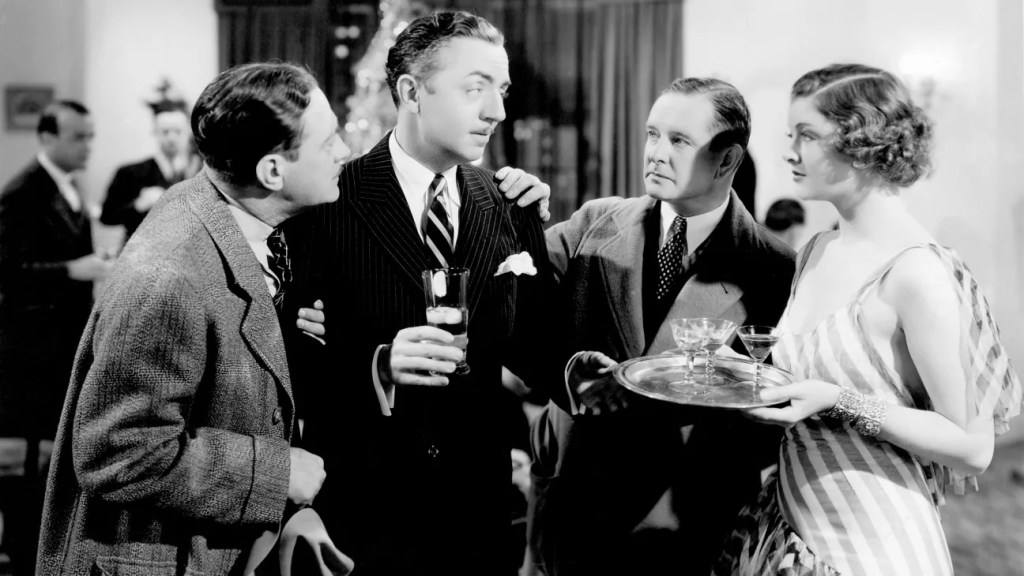
In December of 1933, a condensed version of Hammett’s Thin Man novel was printed in Redbook. In January of 1934, The Thin Man was printed in novel form, and was an absolute best-seller. Considered by fans of the author to be his last, actually-good work, history notes the overwhelming similarities between Nick and Hammett– the Pinkerton resume point, of course, but also the entanglements with strong-willed women. Hammett at the time was in the beginning of his thirty-year relationship with writer and political activist, Lillian Hellman, who later claimed she was the inspiration for the spitfire Nora.
MGM purchased the rights to the book for $14,000 in 1934 (nearly $350,000 in 2025, a number that seems so large it almost takes my breath away), and W.S. Van Dyke requested it to be his next project at the studio. He had Powell– recently transferred to MGM from Warner Bros.– and Loy in mind for the picture, the pair having just starred in his Manhattan Melodrama love-triangle flick with Clark Gable. Powell was, at 42, considered by studio heads to be too old to play Nick Charles (who is 41 in the novel), and they also balked at Loy playing the 26 year-old Nora– not because, at 29, she was too long in the tooth, but because they already had her earmarked for the upcoming Stamboul Quest, an espionage film with Loy in a vampy, Mata Hari-style role for which she was better known. Studio heads told Van Dyke he could have Loy for Thin Man if, and only if, she was ready to shoot Stamboul Quest in three weeks.
Van Dyke shot his whole picture in less than 18 days. And changed the trajectory of Powell and Loy’s careers forever.
Nick and Nora’s onscreen chemistry is no accident– while the novel has them trading flirtations and clearly a dedicated couple in hot pursuit of a murderer, MGM dialed up the flirty banter by hiring husband-and-wife writing duo, Albert Hackett and Frances Goodrich. Nora is a bit one-dimensional in the novel, but in the hands of a female screenwriter, she becomes a dynamite character who can take a punch and handle PR for her husband. Director W.S. Van Dyke urged the screenwriting pair to play up the chemistry between his two leads– Nick and Nora share a number of scenes with just the two of them, and many are coyly in a bedroom or while the couple intimately hang out in their pajamas– and pay only the barest attention to the central mystery plot points of the novel.
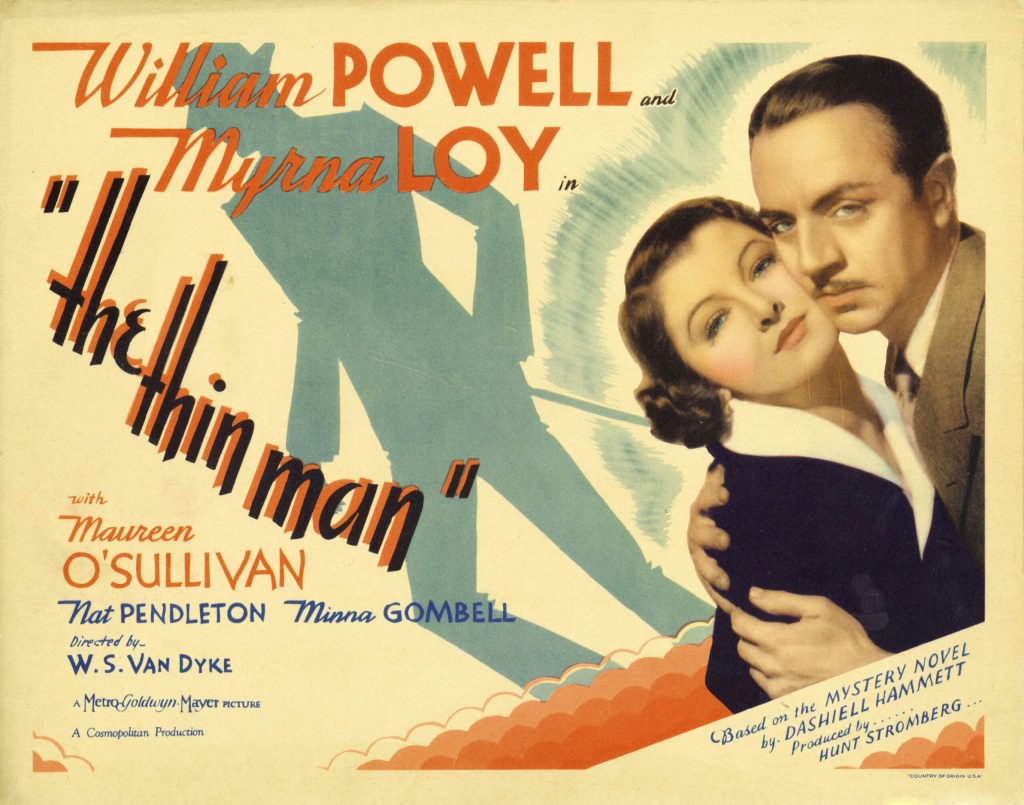
That marching order to make the film flirtatious is fairly evident in the final product. I know I said that this was a perfect adaptation in the opening ‘graph, but the narrative arc of The Thin Man is, frankly, a mess. The book isn’t the strongest whodunnit of Hammett’s oeuvre to begin with, but the movie makes an even greater hash of the story: there are too many characters and blonde actresses that are almost impossible to tell apart; there’s a a convoluted mafia-adjacent subplot and so many inept policemen trod across our boards it feels like the Keystone Cops were borrowed from Mack Sennett’s belly-up studio.
But the fact of the matter is, you don’t really notice because Nick and Nora are just so damn fun to be around. Beginning with William Powell’s introduction on how to shake a martini and Myrna Loy’s pratfall while beleaguered with Christmas presents and one well-cast wirehair fox terrier, audiences immediately love these luminous goofballs for the entire ninety minutes they’re on screen.
Nick and Nora do one thing that is quite a delicate dance– while Sherlock has Watson and Poirot has his Hastings, and Nick is rightfully held up as a competent detective, his sidekick, Nora, is never shown to be secondary or even lacking– despite her gender, despite her dearth of experience, and despite her money. Nora– whose role changes a bit once the Hays code goes into full swing for the second through sixth movies– is observant, patient, witty, and brave. The screenwriters make you wonder how great of a Pinkerton Nick would have been if he’d married Nora sooner. If Nick Charles is going off to his mind palace, he’s taking his wife and dog with him. He was good at catching petty thieves before Nora– but with her, he’s all but unstoppable.
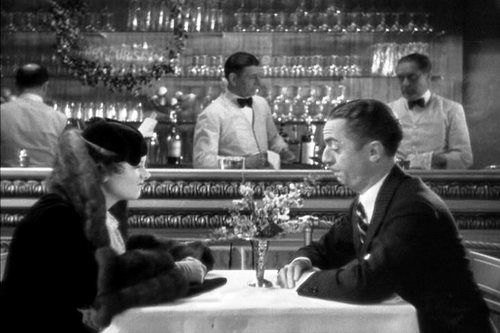
The most galling thing to modern audiences is that moviegoers of 1934– the literal height of the Great Depression– lapped up the lavishness of Nick and Nora’s spending. Designer gowns, tuxedos, piles of presents– everything from air guns to furs – Nick and Nora make no bones about the fact that the economic downturn of the nation isn’t touching them one bit. Early on in the film, Nick deflects the call to solve the Wynant case by joking to his wife, “I haven’t the time. I’m much too busy seeing that you don’t lose any of the money I married you for.”
“Escapism” is often cited as the shorthand for why characters onscreen could be dripping in wealth while avoiding the guillotine, but “screwball” was the real secret weapon for Nick and Nora. Normally used in conjunction with romance, screwballs almost always featured a wealthy person– usually a wealthy woman– being the source of disorder in the film, and then being brought back into order. In this case, we have the chaos demon Nora who just wants a taste of her husband’s seedy past. In the middle of the film, her suite at the Normandie is infiltrated by assorted ne’er-do-wells, and she takes them all in with a smile. But as the party drags on and is crashed by more and more people of the opposite set, she takes the time to snark at her husband, “Oh, Nicky, I love you because you know such lovely people.” Just when she can’t take any more of the upstart Wynants and the criminals around them, Nick manages to solve the (barely coherent) case.
Nora Charles is a screwball heroine in a mystery novel– two genres that require everything be “set to rights” at the end of the story. But her reward at the end of the film isn’t order in the form of a promise of marriage– it’s a murderer getting apprehended by her husband. And the couple’s reward? Well, a very suggestive, 1934 pre-code image of a train chugging along a track. Toot toot!
 msemilyedwards.com
Leave a comment