
In the past month, The Washington Post has been all but completely obliterated and we have watched our country further spiral down the drain into outright fascism. And that descent describes only the official actions of various Departments in the executive branch, hell-bent on destroying the lives of American residents and doesn’t include the millions of name-redacted documents being trickled out by the Department of Justice that (more than) implicate the President and many of his closest acolytes in a vast conspiracy to rig elections, turn the media into a right-wing propaganda machine, and get away with the mass, coordinated sexual assault of hundreds-to-thousands of adults and children. It is, frankly, impossible to think about anything other than what we could do to stop this conspiracy, to stop a conspiracy of this magnitude from happening again, and to punish those who were involved.
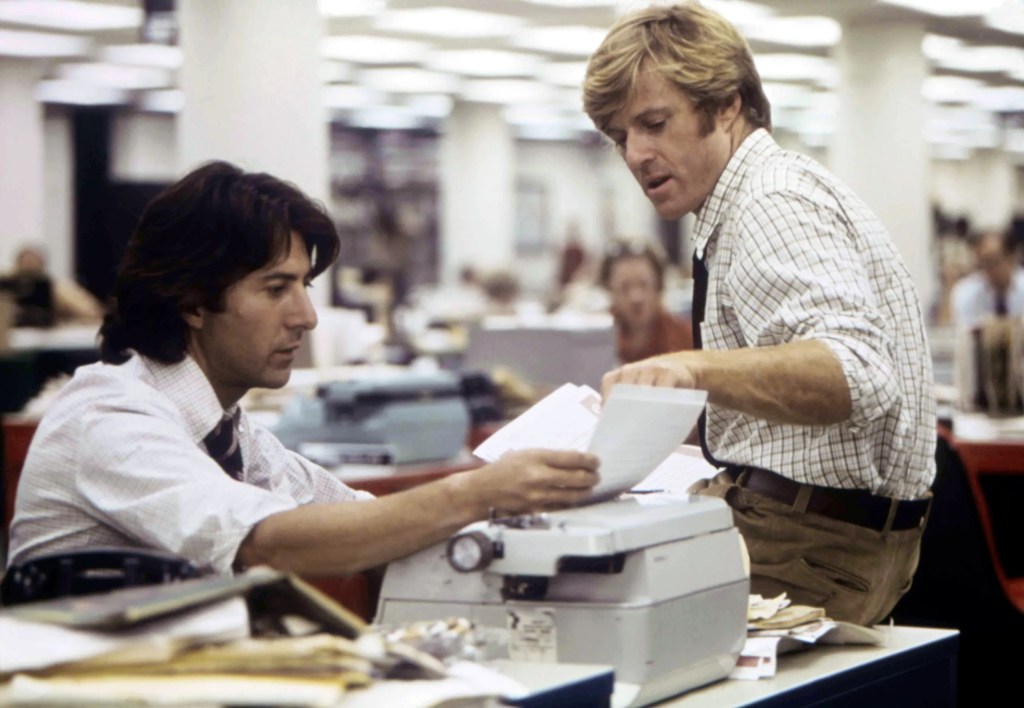
My brain is scrambling to try and find a connection to a time when this was even remotely precedented. So my brain naturally pulled up Robert Redford’s best film, All the President’s Men, directed by Alan J. Pakula and written by William Goldman. But no matter how hard I think about it, what was once the most scandalous thing to happen to the office of the President seems pathetic– almost jejune– compared to today’s horrors.
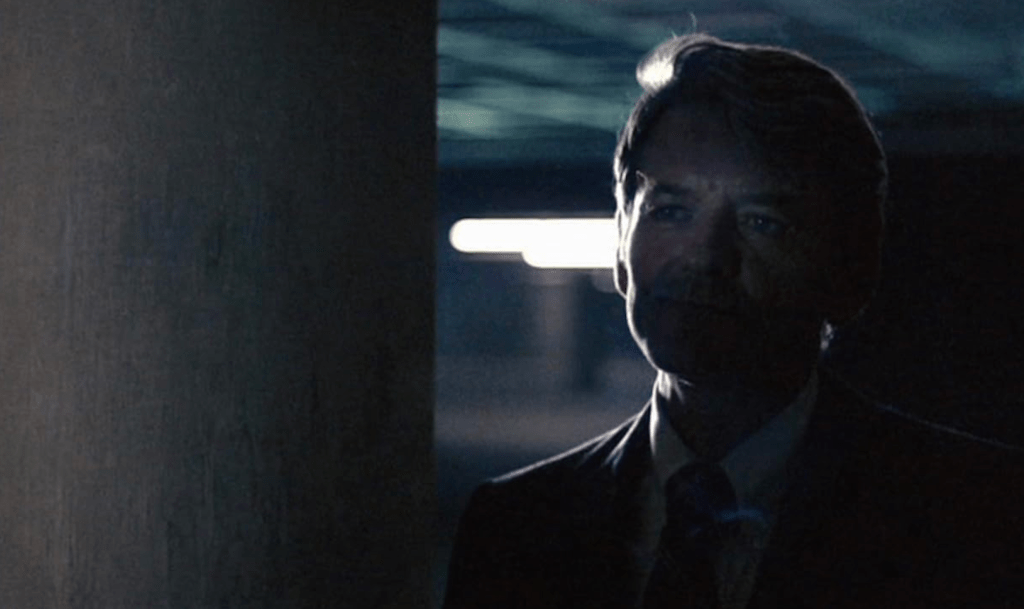
Debuting only a few years after the Watergate scandal actually broke, it’s strange to watch All the President’s Men fifty years after it came out and realize, at the time, that Bob Woodward and Carl Bernstein were entirely in the dark about who was behind the break-in at Watergate. We all take for granted who the conspirators were, now. Who was involved in the espionage ring, what the conspirators were trying to dig up or accomplish, and who they were speaking to for details when they met with Deep Throat in that dank little parking garage? These are all basic tenets of a mystery. At its core, this movie is a proper whodunit– albeit, one without a body found in the library.
The Private Investigator as a framework is an interesting one to work with in regards to a “based on a true story” conspiracy movie. I, personally, believe that the trope encompasses more than just your Sams Spade and Philips Marlowe (and your Vivianas Valentine). A Private Investigator is someone who is paid to solve a case– be it murder or theft or breaking-and-entering. A Private Investigator should have the opportunity to walk away from the case he or she has been hired to do (but usually gets too entwined in the righteousness of that case to walk away). Frequently, their payday does not actually come at the end of the trail, or the appreciation they expect for doing the right thing turns out to be a punishment. The risk for Private Investigators is usually very high, and the reward is very, very low. Often times, the case that the investigator is working is so hopeless or violent– or reaches too high into a power structure– it makes viewers or readers wonder why the investigator doesn’t just drop it altogether to save their own hide.
The realities of the Watergate scandal seem downright de riguer in 2026. Inheriting the (failing, catastrophic) Vietnam War, Republican president Richard Nixon tried to hasten a diplomatic resolve to the fighting… by bombing the living hell out of nearby Cambodia. He (supposedly) thought by killing innocent farmers, governments would be more inclined to come to the table and hash out a truce. What he actually did was ethnic cleansing and/or war crimes.
Called Operation Menu, the bombings were kept fully classified until the early 2000s, and information was only shared with executive and military personnel on a “need to know” basis– personnel including Admiral John S. McCain, father to future senator John McCain. Two years after the attacks, a government source leaked some of this information to the New York Times, angering then-National Security Advisor Henry Kissinger (may he rest in hell), and other higher-ups in the American intelligence apparatus. Nixon and his chief of staff, H.R. Haldeman, became obsessed with finding and stopping leaks in the government. Nixon began recruiting some of the most insane people possible and folding them into plans to sabotage anyone he saw as enemies. Former FBI Agent G. Gordon Liddy assembled a group of men to “stop the leaks” and eventually garnered the name of The Plumbers for his rag-tag group of spies. Similar to USSR tactics of the time, the Plumbers also sought compromising information, or Kompromat, on perceived enemies.
Liddy thought up a handful of operations that got kiboshed before they started (and all of which were named after something Nazi-adjacent, so that tells you most of what you need to know about him), but the most enduring and successful was the Watergate scandal, in which a gang of men broke into the Democrat National Convention offices and tried to wiretap all the phones. They got arrested doing so (they left a lot of evidence of their B&E laying around and even ran into the night watchman). Nixon was also involved a significant money-laundering scheme, syphoning funds from a re-election fund.
If you were wondering about the detail that all of the leaked Epstein emails seem to feature very educated men sending each other missives that read, “I love doing crime with you XXOO” over and over again, you may or may not be pleased to know that Richard Nixon was so egotistical and so dumb, that he was so afraid his presidency would not be preserved well enough for posterity, **he** had the Secret Service install tape recorders in the Oval Office and **that’s** the reason we have so many audio recordings of the President and all of his cronies talking about, and admitting to doing, crimes.
In the words of Deep Throat:
Forget the myths the media’s created about the White House. The truth is, these are not very bright guys, and things got out of hand.
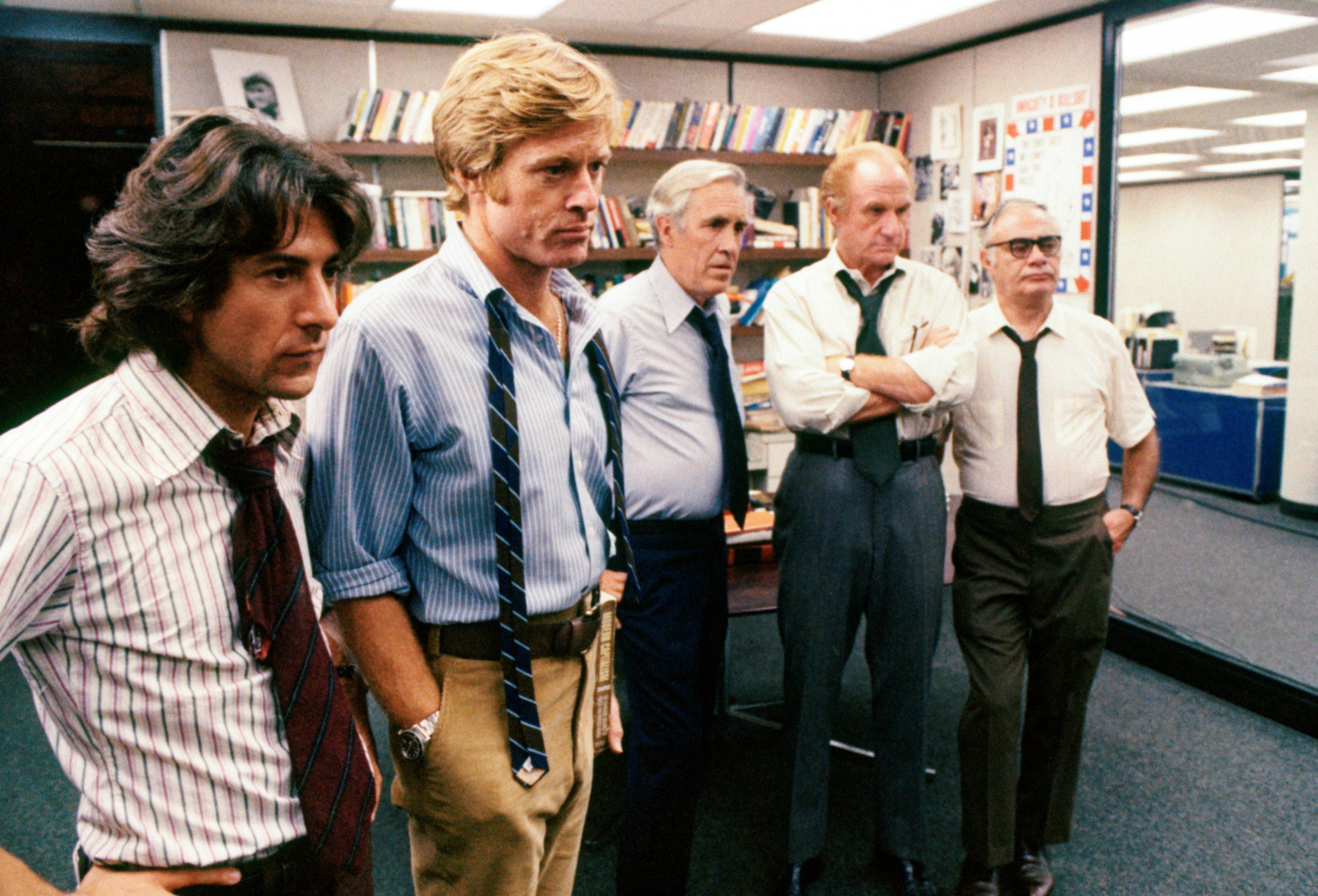
Throughout All the President’s Men, WaPo editor Ben Bradlee (played by Jason Robards) urges Woodward and Bernstein to gather more sources for their reporting. It’s frustrating, as a fiction reader and writer, to see them staunched by their editor every step of the way. If this was a fiction, and if they were fictional P.I.s, they wouldn’t need more corroborating sources. Just one guy is narratively enough. This is one of the greatest parts of the film, to be quite honest. Cases are not made by a singular statement, one tiny piece of evidence. Miss Marple and Hercule Poirot might get confessions to murder based on half an overheard telephone conversation but we should be relieved that that is not the case in real life. Robards won an Oscar for this thankless role, and he deserved it. More than even the corrupt Richard Nixon Bradlee is the emotional antagonist of this story. If your protagonist is the person who changes during a story (Bob Woodward, a young reporter who must learn how to report by cutting his teeth on the most important story of a century), the antagonist is the person who stands in his way. And in this case, that is Bradlee, who is only trying to help him build a better foundation, and not just let him rush into breaking uncorroborated news, and subsequently keep the Washington Post intact.
One of the most interesting parts of All the President’s Men is the aspect of the Private Investigator in which he must be punished by pursuing a righteous cause. Woodward, and to a lesser extent the sardonic and jaded Bernstein, is emblematic of the naiveté of someone who genuinely believes in the American government. At some point during the film, the script even forces poor Robert Redford to deliver the line, “I’m a Republican!” which isn’t believable at all coming out of our golden-haired lefty God.
But the fact of the matter is, Woodward, Bernstein, and Goldman– at the time that this movie was made– conceivably thought that the worst thing the government was up to was domestic spying and skimming money out of a campaign fund– not the ethnic cleansing of Cambodia and Laos– and that was enough to horrify them. In the ’70s, White Americans clearly believed in the sanctity of the White House. (Non-white Americans knew better… the FBI, through various COINTELPRO programs, had already killed plenty of American-born, Black-, Native-, Latinx-, and other POC-rights activists.) The thing at risk for Bob Woodward looking into the story of a lifetime was destroying his own belief in the righteousness of the American government, and to an extent, White Heteronormative Patriarchy. And the guy he probably voted for.
And that is, unfortunately, the largest parallel between this film and where we stand today. I have seen– and you have also seen– dozens and dozens of social media text posts and video reels from men who are utterly flabbergasted at the idea that grown men want to predate on young children, and that there are far-reaching mechanisms in place to let them do just that. The majority of posts seem to attribute this to the “Epstein class,” but to paraphrase a friend, plenty of blue collar men would also like to go to Child Sex Abuse Island, they just weren’t invited. Jude Doyle has an excellent essay in his newsletter about how it is self-exculpatory to attribute the crimes of Trump– at least when it comes to sexual assault– to his ties to wealth and economic prosperity and not just patriarchy as a whole. I suggest you read it and sit in discomfort when learning about how common these kinds of crimes truly are.
When the crimes of Donald J. Trump are eventually flattened into a narrative, I can’t help but wonder– who will the hero be? Who will be credited with digging to the bottom of his absolute mine of shit, his bottomless chasm of soulless harm? Will it be a male reporter, or will it be one of his victims? I ask only because in 1976, one of the first people to call the press and sound the alarm about Watergate and Richard Nixon was Martha Mitchell– a woman held prisoner by her complicit husband, drugged into submission, and silenced by the fact that her sole press contact was with the female reporter, Helen Thomas.
Sorry for the extremely poorly timed, shameless plug, but Viviana Valentine and the Ticking Clock is one of today’s Kindle Daily Deals. You can pick it up for just $2.99 over on Amazon.


 msemilyedwards.com
Leave a comment