
I don’t read a lot of cozy mysteries. The genre can bother me a little bit– pick up a wrong ‘un and it can be deeply Christian and conservative, astoundingly saccharine, and naive to the ways of the actual world. While I have plenty of political issues with the Private Investigator conceit, and, of course, with the cop procedural (which I don’t even consider a mystery genre but something else entirely), cozy can oftentimes feel too naive and too obsessed with reducing an abusive reality into the “true neutral” idea that we all wish to live in a closed-off, small town with no outsiders, where we know all our neighbors and one of them is always a Christian religious leader. I am, I suppose, too much of a City Mouse to really enjoy a genre populated by Country Mouses.
But, for me, one of the most enjoyable “twists” on the cozy genre is the medieval monk mystery. I know what you’re thinking: Emily. You grew up Catholic and ran away from the Church as soon as possible, practically throwing glitter in the air as you sprinted. Two of your gripes about the cozy genre in just the previous paragraph were about Christian hegemony in mystery literature. Why the ever-loving hell would you care about medieval monks?

The key, of course, is cloistering.
While Miss Marple wants to protect the small-town nature of St. Mary Mead for whatever reasons she has, I have less of an issue with the cozy conceit of an isolated society if there’s an actual, real reason a society would be isolated. A cloistered abbey is by its definition sheltered from outsiders in ways that St. Mary Mead shouldn’t be in post-War Britain. Cozy mystery settings often feel like The Truman Show– the people in them are oblivious to the concept of a highway, and are the types of people who would obsessively check the NextDoor app ready to narc on anyone who they consider from the “outside.”
At the beginning of the COVID lockdown, I rocketed through the entire Brother Cadfael series by Ellis Peters. I genuinely adore Cadfael, a Welsh monk who saw a whole lot of the world before taking vows and taking to an abbey in his later years. When I kept looking for Silver Screen Sleuths to cover for this series, The Name of the Rose was on every list. I was like… fine. I’ll do it. I know what to expect from a monk mystery. I’ve read dozens and dozens of them!
The Name of the Rose

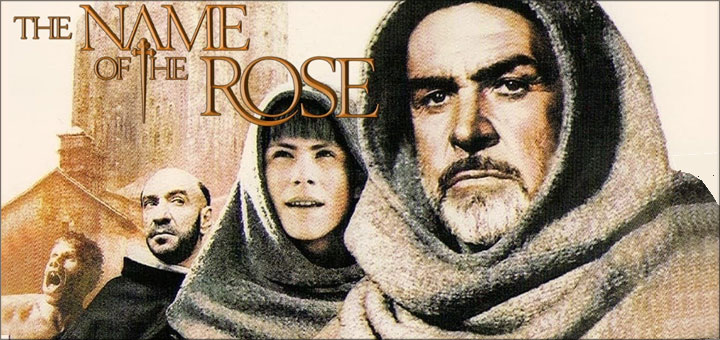
The film was directed by Frenchman Jean-Jacques Annaud off of a screenplay by four different writers (Andrew Birkin [Jane’s brother], Gérard Brach, Howard Franklin, and Alain Godard [no relation to Jean-Luc]). It stars Sean Connery as William of Baskerville, a Franciscan, who is visiting a Benedictine abbey in Northern Italy with his protege, Adso of Melk (Christian Slater, the living embodiment of the transformational power of puberty). The two are there for a theological conference, but just before their arrival, the body of a young “illuminator” (the guy who illustrates hand-copied manuscripts) is found in a ditch.
Everyone is lucky that in addition to being a learnéd monk, William is also an inquisitor and a damn fine detective. In the original novel, written by Italian author Umberto Eco, William has the physiology of Basil Rathbone and the name William of Baskerville is a direct nod to possibly the most famous Sherlock Holmes book ever written, The Hound of the Baskervilles. Sean Connery bears no resemblance to Basil Rathbone, but he wanted the part, so he got it. (FWIW, director Annaud didn’t want Connery for the role because he thought it would be distracting to have 007 playing a monk. He was right.)
Church politics and poverty politics abound in both the book and the movie.
There’s a mentally and physically disabled monk named Salvatore (played by Ron Perlman) who speaks in a combination of tongues and is undermining both the culture of the cloister and his own vows of chastity. There’s Brother Jorge (played by Feodore Chaliapin, Jr., the grandpa in Moonstruck) who believes it is against religious orders to show joy. There’s another inquisitor on hand– the very real Bernardo Gui (F. Murray Abraham)– who is ready to light the local whore on fire. Someone gets drowned in a vat of pig’s blood. The monks perform acts of charity by making the local townsfolk dig through their refuse for food. No one has seen a bath in weeks, if not months. Overall, everything about the movie is repulsive.
Annaud apparently did that on purpose. According to IMDb trivia (which is not always the most reliable, but I believe it here), he cast some of the ugliest actors he could find for supporting roles:
“He wanted the characters to appear ‘real’, based on the men in the village where he lived. When he returned to his village, some of the men asked him if he really considered them to be as ugly as the actors, and he said, ‘Yes.’”

As I admitted over on Bluesky, I tried to read Eco’s novel before sending out this newsletter, but Various Life Emergencies got in the way and I only got through a few hundred of its 600 pages. Mea culpa. I read enough, though, to have weird feelings about it. Eco undeniably wanted to play with the tropes of a mystery novel. It is, at its base, Sherlock fanfic, and then it gets somewhat lost in the weeds of knowledge Eco pulled upon to build the world and the plot. The writing gets very list-heavy at times and dialogue often gets trapped in long (LOOOOOOOOONG) theological spars between the warring monk factions. It is not an easy or quick read.
The book is excellent and Eco deserves all of the heaps of praise he received for it. Eco was medievalist–turned–celebrated philosopher and semiologist in Europe and a prominent thought-leader in the world of literature to whom we are all, actually, indebted whenever we write our silly little blog posts about books and film. The novel is loaded (again, it’s like 600 pages) with symbols and tropes that wink and nod to the various worlds in which Eco was himself entrenched. You can read the book and enjoy it without fully comprehending the various theological debates that happen between the warring branches of brotherhood, as well as the the various rules and strictures that govern ecclesiastic behavior. Eco understood, and artfully leverages, the limits of scientific knowledge of the medieval times, a gimmick that makes most historical mystery novels all the more exciting to read. How will a monk of the early 1300s solve a crime with no modern science? Why is it important that William is a Franciscan in a pool of Benedictines? What is the motive behind these pointed murders?
The New York Times review of the 1980 novel says, “The novel is a mystery, the most rationalist of all literary genres, based on a determination to reach irrefutable, if partial, truth.” And I do think it’s important that William is given the opportunity to investigate homicides and figure out who is bumping off the brothers and why.
But I do not think the novel should be considered mystery fiction.
As Eco said in his own Postscript to the Name of the Rose, “very little is discovered and the detective is defeated.” At the end of the novel, Bernardo Gui– the single-minded inquisitor– remains living, and, even though the reader is privy to the fact that William is a forward-thinking logician of modern perspective, what reigns supreme is, well, the Catholic church of the 1300s. There’s a whole lot of witch burning, war, and oppression ahead. It’s hard to call that a resolution of order.
Annaud’s feelings about the Catholic church are fairly evident– he is an atheist, and goes to great lengths to show William to be a man of faith but not a man of the cloth. He is a brother, a monk, a church leader, but he is not someone who will, any longer, be used to further the goals of the church as an institution. It is only in translation to the screen that Name of the Rose starts to become mystery fiction. {SPOILERS}: William of Baskerville’s investigations into the murders of seven monks in a cloistered abbey results in a different outcome from the book– Bernardo Gui dies in a carriage accident (removing his zealotry from the Church’s future), the innocent local girl gets saved, and William and Adso literally ride off into the sunset to continue their investigative work together, a la Holmes and Watson. Adso is tempted by the local girl to stray from William’s side at the end of the film, as Knights Errant frequently are, but like a good Galahad, Adso denies himself the earthly pleasure and stays committed to acts of Honor.
The movie itself is not terribly good. Part of the reason for that is the veneer of repulsion that Annaud put over top the text. In the book, the abbey is splendid, the food sumptuous, the church reverent. On film, you can practically smell the manure, the rotting vegetables, the actors’ unbrushed teeth. Verisimilitude taken a step too far. If the the cloister is essential to the viewer’s desire for order– if we are expected to want the monks to go back to being happy and not-murdered– it is somewhat natural that we should expect to see their living conditions be, I don’t know, tolerable. If an essential aspect of the cozy monk murder is a rural idyll, going out of one’s way to make everything ugly, and having William reset the chess pieces back to a norm of filth, is jarring. Connery is entirely miscast, and Slater looks and sounds too fresh from LaGuardia High School to be a convincing Austrian novice. Perlman as Salvatore is committed to the bit, but through a modern lens, the bit goes too far. F. Murray Abraham does an excellent Christopher Lee impression. It’s all too much. And on top of that, the denouement of fire and death feels too Indiana Jones once it’s brought to screen. Connery takes a swing to the swashbuckling instead of ending as an erudite know-it-all, which is what we expect from Sherlock Holmes.
Which begs me to ask: am I being too persnickety when it comes to defining what is or is not a “sleuth” movie?
At its essence, The Name of the Rose follows many familiar tropes: monks in cloister, the question of whodunnit, procedural attaining of evidence, resolution. But something is just not sitting right. Just a movie containing a murder investigation does not make it a sleuth movie. The messaging and resolution is too far off for me to equate this with something along the lines of Brother Cadfael, a series that roots itself in the idyllic values of gentleness, calmness, and quiet. There’s nothing idyllic about a monomaniacal monk going full Attic Wife on his fellow brothers. Call it an evangelical thriller, but don’t call it a mystery.


Leave a Reply to RachaelCancel reply