
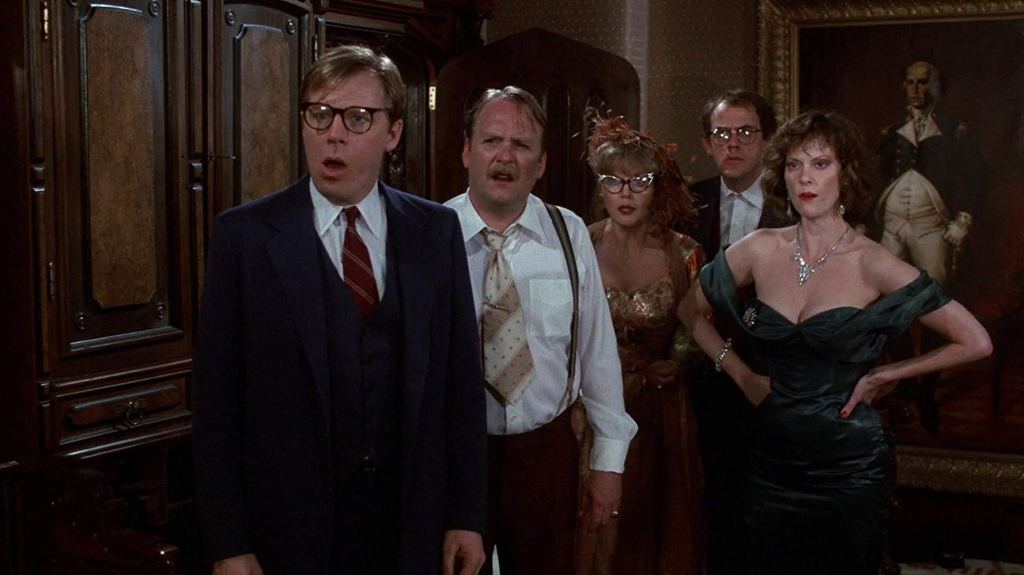
Though I’ve seen the film approximately a thousand times, I finally took notice of something I’d never paid attention to before in the 1985 movie CLUE:

When Professor Plum picks up Miss Scarlett, he asks her where her dinner party is. She gives the address of “Hill House, off Route 41.”
Already, thanks to a text overlay when Tim Curry’s Wadsworth arrives at the home, we’ve been told that the film takes place in New England in 1954. A quick goog reveals that Route 41 in New England runs through Northwest Connecticut and into western Massachusetts, dead-ending in the town of Pittsfield, Mass.. In 1954, Shirley Jackson was living in Bennington, Vermont, a short 34 miles from Pittsfield.
I am not saying that screenwriters John Landis, Jonathan Lynn, and Anthony E. Pratt purposefully made a movie about a bunch of Cold War miscreants ending up in Shirley Jackson’s universe, but I’m also not not saying that.
(Also: remember finding anything with just paper maps? God, that time sucked.)

I’d never before correlated the cozy manor house mystery with a capital-G Gothic horror story, but obviously so much of it follows the same path that I feel silly for not thinking about it sooner.
Before you say anything, Wilkie Collins’s Woman in White can be read as a piece of Gothic mystery fiction, but it is probably more accurately a “sensation novel,” and was more about disrupting British Victorian perspectives on class order than it was about sussing out a murderer. Both CLUE and The Haunting of Hill House are much more *American*.
Basic story beats are repeated in CLUE (and most manor house mysteries) that mirror The Haunting of Hill House: A mysterious man invites several people to an out-of-the-way country home. The home is plagued with violence, family secrets, and death. There are unexplained events, noises in the night, and suspicious behaviors. Though CLUE notoriously has three separate endings and not just one “whodunit,” most country house murders end similarly to Jackson’s Hill House– one character is accused of “causing” all of the disturbances and is jettisoned from the house, removed from the story so s/he can cause no more harm. Whether it’s an arrest or a death, the perpetrator of the disturbance in a manor house mystery is usually pinpointed by our sleuth and stopped.

Per an article on the New York Public Library website, “The battle between humanity and unnatural forces of evil (sometimes man-made, sometimes supernatural) within an oppressive, inescapable, and bleak landscape is considered to be the true trademark of a gothic horror novel.” Multiple times in the first fifteen minutes of CLUE, a character remarks that they have been brought to “this horrible place,” meaning a large manor house in the middle of nowhere, in the rain. (As someone who has lived in Northwestern Connecticut, I bristle slightly at this as it is, in my opinion, one of the most beautiful places in the entire country, but so it goes. The exterior of the house is the former Max Busch Mansion in Pasadena, which unfortunately burned down in 2005.)
The piece goes on to say, “Early novels in the gothic horror subgenre heavily feature discussions of morality, philosophy, and religion, with the evil villains most often acting as metaphors for some sort of human temptation the hero must overcome.” If that doesn’t fall in line with a murder mystery, I don’t know what does.
Each of the six houseguests in the film CLUE– Miss Scarlet (Lesley Ann Warren), Mrs. White (Madeleine Kahn), Mrs. Peacock (Eileen Brennan), Mr. Green (Michael McKean), Colonel Mustard (Martin Mull), and Professor Plum (Christopher Lloyd)– work or live in Washington, D.C. and are being blackmailed, by Mr. Boddy (Lee Ving), the main murder victim in the conceit of the game and the first murder victim onscreen. They are all purveyors or victims of vice, according to their times’ morals– a madam, a murderess, a corrupt politician’s wife, a homosexual, a war profiteer, and a lecher. One of my favorite parts about CLUE is that many of the blackmailees are so unapologetic about their “sins”– Miss Scarlett is rather proud of her business, Mrs. White doesn’t seem to miss her murdered husband(s) at all. (“He wasn’t a very good illusionist.”) The movie makes no attempt to keep innocent people alive, either– the cook, the telegram girl, etc., are all revealed to actually be informants and essential to the act of blackmail. Everyone is fair game, and can be a victim of “the house” and the Gothic message of cleansing sins.
Per Britannica, “Gothic novels commonly use such settings as castles or monasteries equipped with subterranean passages, dark battlements, hidden panels, and trapdoors.” I love this detail being teased out– certainly, Castle of Otranto, the novel credited with being the first-ever Gothic tale– features an entire dungeon maze. But of course, this is a feature of many country-manor mysteries, including my own.
In Gothic novels, everyone is kept in the house until the house is ready to reckon with them. Certainly in Jackson’s Hill House, Theodora and Eleanor can’t even take a walk around the grounds without getting haunted by the weird picnic party. In CLUE, they’re kept indoors by locks and the hell hounds outside (a pair of German shepherds out front and a pair of Dobermans in the back. German breeds, to add to the specter of Communism!)
Of course, at some point CLUE needs to become a comedy (you don’t hire that cast without zaniness kicking in). But I want to go back and re-watch a number of country house murder movies and apply the analysis of Gothic literature to each of them. There’s really no difference between an avenging spirit and an avenging private investigator, in theory. It’s just that Mr. Green gets to go home and sleep with his wife.

 msemilyedwards.com
Leave a comment