

Like many reviewers for this movie, I recall being enraptured by the trailer when it first landed. I remember seeing the neon glow, fast cuts, and dripping rain and being all-in on the flick. I was very excited for the movie– written, directed, and produced by Cabin in the Woods director Drew Goddard– with dialogue that promised a repartee that rivaled the best hard-boiled movies of the 1940s, plus tons of style. I love a movie with style.

The gist is this: in Twin Peaks, Washington Lake Tahoe in 1969, on the California/Nevada border, there is a hotel bifurcated by the state line (for those of you playing David Lynch Bingo [DLB]: a liminal space!). On one side, sunny California and the promise of the American west. Also, alcohol. On the other, the den of iniquity that is Nevada and all the gambling and chance that goes with it.
The setting here is its own character, as it should be in any mystery. I really do mean that: technology, laws, social norms, and expectations dictate what are or aren’t believable constraints in a mystery movie. This is 1969, and we’re heavily playing with racial stereotyping, sexual freedom (DLB: intimated statutory rape), and the loss of the Wild West.
Years prior to our film’s beginning, the El Royale was a hotbed for America’s rich and famous to come and do as they pleased. Whatever they pleased. But since the often-alluded to but always mysterious “management” lost their gambling license, it’s been dead quiet. On top of all of that, ten years ago, after a bank heist gone bad, someone buried a duffle of dollars beneath the floorboards.
That is what we know.
After the violent cold open and a couple of excellent needle drops (Quentin Tarantino Bingo is a separate but equally winnable game), our story begins. We start with Father Flynn (Jeff Bridges), Darlene Sweet (Cynthia Erivo), and Laramie Sullivan (Jon Hamm) arriving at the El Royale almost at the exact same time, a thing that has never happened to me ever at a hotel. The lobby boy is nowhere to be found no matter how loud Laramie’s voice is and how many times he rings the bell. Laramie plies everyone with coffee (DLB: Coffee!) before Darlene finally slams on the door to the maintenance hallway and wakes Miles (Lewis Pullman) into service. The queue for rooms is further upended when Emily (Dakota Johnson) screeches into the parking lot, acerbically. She greets everyone in the lobby, acerbically. She signs in, acerbically. She goes to her room. Acerbically.
We’re maybe 20 minutes into the movie at this point and although some parts of the writing are a bit silly (that accent! that pissiness!), it at least lets us know that the movie is aware it is setting up pins to knock them down later. I have no problem with that. I don’t need movies to feel like slice-of-life voyeurism. Sometimes I’m here for a stylistic ride. And this is a stylistic ride. Kind of like Emily’s revving Mustang.
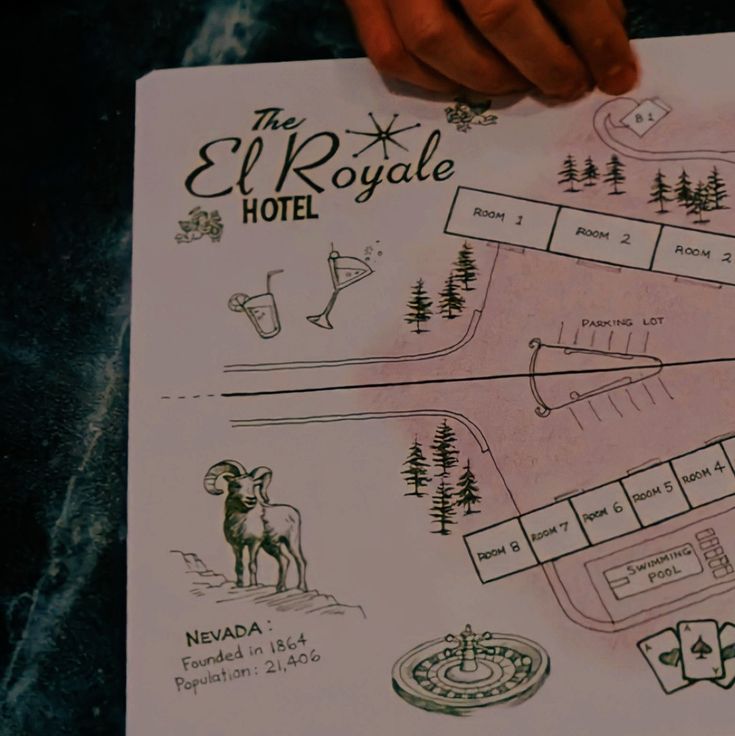
Through a series of POV sketches (QTB: picaresque storytelling!), we become aware that we are playing a variation on Seven Card Stud: some cards face up, some cards dealt down.
Card #1: Our first face-down card. Jon Hamm’s character is not a traveling vacuum salesman, he’s an FBI agent (DLB: lawman!) and he’s been sent by J. Edgar Hoover himself to find “tapes” at the El Royale. But in addition to sniffing out all the bugs and recording devices in his honeymoon suite, he can sniff out something is wrong with each of the other guests.
Card #2: Father Flynn is in disguise and he’s actually an aged bank robber (QTB: guys in dark suits, guys on the lam), fresh out of jail, who needs to dig up the El Royale’s floorboards in order to find his buried treasure. He goes to town digging up his room– but no bag. It’s in:
Card #3: Darlene’s room next door. Darlene is our only “real” face-up card– she is exactly who she says she is, and she’s in town for the most innocent of reasons. She’s a soul singer (QTB: lots of Black culture in an otherwise all-white movie!) just on her way to a low-paying gig. I’d argue that Flynn is also a face-up card because his money is a red-herring (QTB: a baker’s dozen maguffins). It genuinely doesn’t matter to the climax of the film.
Card #4: Emily, another major face-down card, has kidnapped her little sister, and tied her up in the hotel room. Laramie doesn’t know that the hogtied teen is being “rescued” from a Manson-like cult in California. Against Hoover’s direct orders, Laramie decides to rescue the kid. And gets extremely murdered in the process. (QTB: Hot & leggy broad begets violence.)
Card #5: Rose (Cailee Spaeny, showing quite a lot of the Priscilla she will soon be famous for) is a face-down card. She’s coming off of an unspecified high– perhaps the high of murdering two people– and is comatose in her room with her sister.
Card #6: Our singular hotel worker, Miles, is behind the taping of elicit behaviors at the El Royale but since his time in ‘Nam is having a spiritual breakdown. Nervous and terrified to have this many un-blackmail-able people in his hotel, he can see everyone’s cards, and everyone has a losing hand.
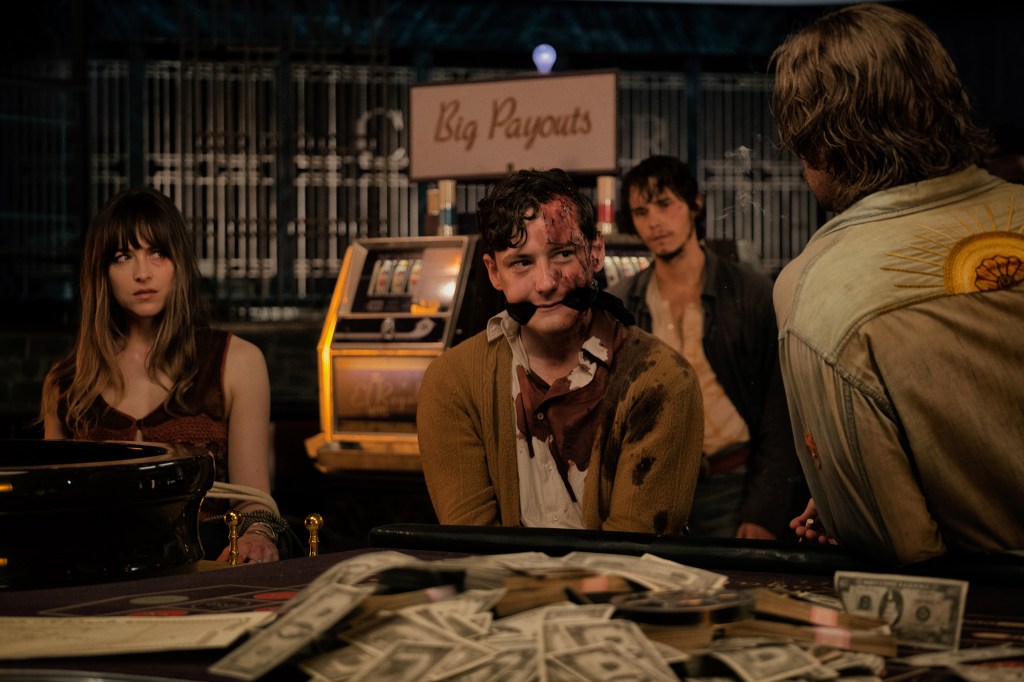
Card #7: Billy Lee. Turns out, Rose doesn’t want to be rescued from her cult, and her messianic fuck toy played by Chris Hemsworth’s lithe and hairless torso, I mean, Chris Hemsworth. (Forgive me, the movie spends so much time gazing at his hip flexors you’d be surprised to learn that the actor has a head.) After Emily blasts Laramie, Rose is left alone for 30 seconds and manages to set the denouement in motion. It involves cults and fire and shooting people and is like Lynch and Tarantino collaborated on the same Google doc.
Many reviews of this movie are scathing, which is something I understand but don’t necessarily agree with. I agree with a lot of the pointed critiques– it’s contrived to just happen to have all of these disparate people show up on one random night at a deserted hotel. At least in a lot of locked-mansion mysteries, people are invited. There is no way a hotel literally anywhere only has one staff member. Jon Hamm’s accent work is atrocious, even if he’s trying to be off-putting when he’s putting it on. The entire movie hits the skids once Billy Lee becomes integrated into the plot, a whopping 51 minutes into a 2:22 minute movie.
It can feel a little “Florals, for spring? Groundbreaking” to watch a crime movie this day and age with multiple homages to Tarantino and Lynch. But, I personally don’t really mind it. This film is playing with a setting that both of those filmmakers love, but hadn’t really yet shined a light on its seedier side. Debuting a year before Once Upon a Time in Hollywood, El Royale elaborates that the Summer of Love was not, in fact, a left-wing, free-love utopia for many, but rather a season of sexual exploitation and rampant abuse. And it doesn’t let you shy away from it one second! Even if the revelation of this thesis statement makes the back 90 minutes feel like a different film than the first 60.

I have no idea when Godard began writing this film, but it feels very much a product of the heyday of Lost, a TV series that blended science fiction and noir sensibilities very well (until, ya know). Goddard wrote nine episodes of the show, for crying out loud. El Royale unfortunately begins to drown a bit under the weight of its own lore and inspiration. If Netflix still can’t figure out that many of its single-season series should actually be two-hour movies, Bad Times at the El Royale doesn’t seem to quite grasp it should be a three-to-six-part miniseries rather than a too-long film.
I think, sometimes, when you’re dealing with noir and dealing with mystery and dealing with conspiracy, the desire is to be clever. And this movie is! You genuinely don’t expect Rose to be the pain point that eventually takes people down. It’s clever that we never find out what’s on the tape that’s worth more than the bag of cash. It’s clever that Miles was a sniper in the war and saves people with the actions that he knows will damn him. It’s clever that, as Darlene and Father Flynn sit on either side of the dying Miles, we have a Black woman and a White man playing with the themes of good and evil, sitting oh either side of the imaginary line that separates a state known for sin and the state known for sunshine. It’s clever, all around.

There’s a line from the great play-turned-movie Harvey, starring James Stewart. It goes, “In this world … you must be oh so smart or oh so pleasant. Well, for years I was smart. I recommend pleasant.” And while it’s hard to be pleasant in a hard-boiled noir movie, what I realize is that you do need to have heart. A moral center. It can be a heart that is hidden behind calcifications so thick they’d be on the tour at Carlsbad Caverns, but the heart must still be there. While much of the cleverness of Bad Times at the El Royale is that we have all of these concurrent timelines, and Jesus imagery up the wazoo, I wish that Goddard had focused us on a main character, the heart in his movie:
Darlene.
I can’t think of a single noir movie with a Black female lead off the top of my head, though a quick Goog reveals that Steve McQueen’s Widows, starring Viola Davis, came out two weeks before El Royale and was technically Erivo’s movie debut, as she played a supporting role. But that’s it!
We know while watching that Darlene is the most imperiled person in the entire film, even if she is handy with a wine bottle. But the movie turns just shy of fully making her the audience’s stand in. She creates an alliance with Father Flynn– it’s Jeff Bridges, so we know he’s not evil evil– and gives us a handy Grizzled White Man Buffer option, if we’d prefer. Which is a shame. It’s Darlene who is making her way through the world honestly. It is Darlene who insulates herself inside a room as to not step on the toes of anyone else at the hotel. It is Darlene who, when tied to a chair and a gun to her head, tells Billy Lee that she won’t fall for his false idols:
Darlene Sweet: Let me guess, it’s some man who talks a lot. He talks so much that he thinks he believes in something… and really just wants to fuck who he wants to fuck. I’ve seen it enough. I’m not even mad about it anymore. I’m just bored. I’m just tired of men like you. You think I don’t see you for who you really are? A fragile little man, preying on the weak and lost.
Billy Lee: Yeah, well, if I…
Darlene Sweet: [Interrupts him] I’ve heard it. And I don’t care. I’d rather sit here and listen to the rain.
At the outset of the film, Laramie, Father Flynn, and Darlene are standing in the lobby, unable to begin our story. Laramie has been standing there yammering away like Foghorn Leghorn doing the monologue from MacBeth and can’t seem to wake Miles up to help them. After instigating Father Flynn to ring the bell, the other white man’s polite ding-a-ling can’t seem to wake Miles up, either. Darlene, tired of hearing these two men just yammer (I cannot stress enough how much we hear Don Draper talk!!!!), she, with a solid thump, gets Miles to wake up. The hotel’s neutrality is undone by Emily’s introduction– a self-righteous white woman unaware of her sister’s complicity in patriarchal violence. At the end of the film, after hearing Billy Lee talk and talk and talk and talk and Father Flynn try to get him to move on, it is Darlene who manages to wake the meek and diminutive Miles up from his guilt-ridden coma to their collective danger and gets him to stand up to the 6’4″ adonis, Billy Lee.
I doubt, in 2018, that Goddard meant for this to be an analogy for our society, but he gets pretty close to a vital message for our time: listen to Black women, not the white men who won’t shut up. If you don’t, you just may end up losing it all.
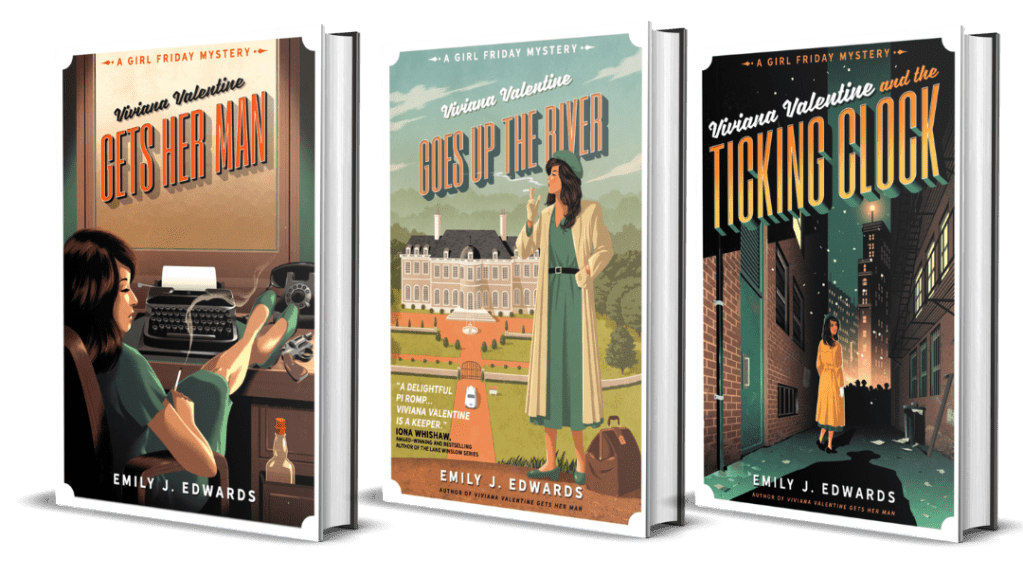
Just like last week, I have a short story out this week! Over at Pistol Jim Press, I write a short based on the theme of “nails in the coffin.” Read Polished here.

 msemilyedwards.com
Leave a reply to Silver Screen Sleuths Noirvember: Dead Men Don’t Wear Plaid (1982) – Ms Emily Edwards Cancel reply