
Twenty years ago when I first moved to Los Angeles, my boyfriend (at the time) and I used to go “shopping” on Rodeo Drive. And by that, I mean we’d poke around in stores and look at a bunch of things I could never buy, while sales people watched us to make sure we didn’t steal anything.
One day, we were in Hermes, looking at neckties. On occasion, my then-boyfriend would splash out on things he couldn’t actually afford, so we spent more time looking at men’s accessories than anything else. Another young man was in the tie section, and cornered me: would I help him pick out a tie?
The conversation was pointed– Oh, he said, I just have so many Hermes ties already at home. Do you prefer this tie, or this tie? Blue or green? That one looks too much like my Gucci ties. I just have so, so many at home.
If this wasn’t a strange enough encounter because I was already shopping *with my boyfriend*, the odder wrench in the works was that the guy who was clearly trying to get attention was an Orthodox Jewish man. He had all the regalia on at the time. He was younger and clearly by himself, and probably wouldn’t have been so overt if anyone he knew was in the store with him. But at the time, and obviously now, I wondered why he spent so much time chatting up a girl who was obviously not a part of his community. God forbid I had thrown my boyfriend to the wind and said to this fella, “Let’s paint the town red,” what would it take, really, to move someone into a relatively cloistered religious minority? Could I give up my atheist ways for a guy who’d buy me nice things, even though I’d have to go through a religious education and conversion, cover my hair, wear long skirts, and avoid using light switches on Saturdays?

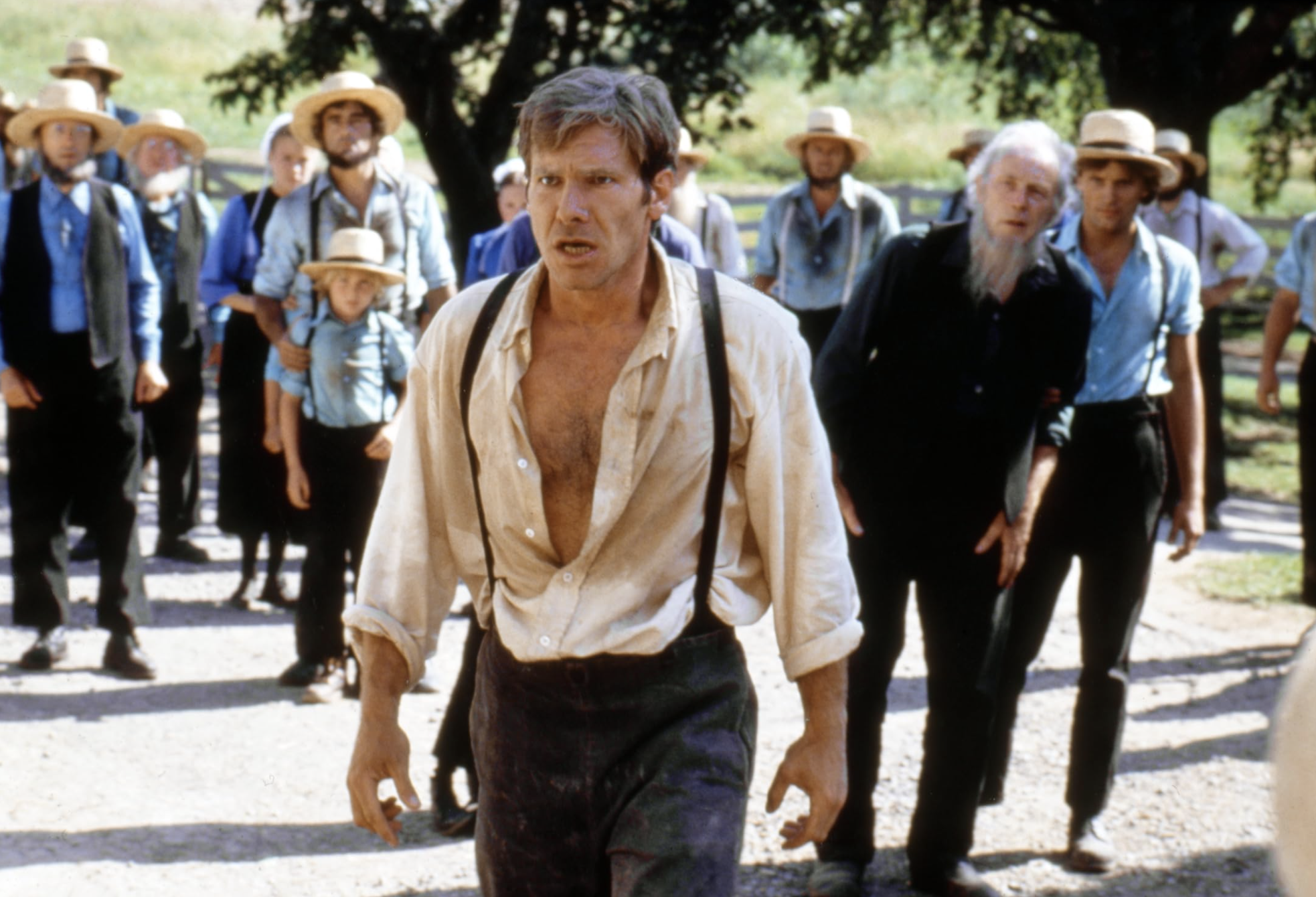
Obviously, a Los Angeles Orthodox Jewish woman experiences more of the world and modern life (including, as implied, lots of well-made French leather goods) than an Amish woman in 1985. But watching the movie got me thinking a lot about the central conceit of Witness: outsider religious communities and justice.
Can the “simplicity” of an outsider life can turn a man away from everything he’s ever known?
The screenwriters– William Kelley, Pamela Wallace, and Earl W. Wallace– are playing with the mystery genre really well in this entire film. Everything is logical, tangible, and rooted in reality even if the log line– “While protecting an Amish boy – the sole witness to a brutal murder – and his mother, a Philadelphia police detective is forced to seek refuge within their rural community when his own life is threatened”– is downright laughable. Could you imagine pitching a Hollywood executive with this story, the same year the same studio made Beverly Hills Cop? “Do I have a story for you, fellas! It’s about the sex appeal of the Pennsylvania Dutch!”
Two big subcategories of the sleuth are happening here: we have the obvious Police Procedural and the cozy mystery. We’ve discussed the tenets of the cozy before– outsider nature of the sleuth, closed communities with a focus on the rural idyll, a general narrative reliance on suspicion of the other. All that is obviously here when Ford’s character, John Book, arrives in Western Pennsylvania with baby Lukas Haas’s Samuel, who is the witness to a murder committed by at least one corrupt police officer (surprise! Danny Glover!), alongside his mother Rachel (Kelly McGillis), a recent widow, who wishes to protect her child from men outside of her community.
A police procedural narrative is not always a sleuth story.
Though, ostensibly, the heroes in crime fiction are always trying to find out who committed the crime, Law & Order doesn’t have the same moral compass, or moral purpose, as a police sleuth, like noted French literary character, Inspector Maigret. Law & Order is, as much as we love Mariska Hargitay, pure copaganda. Copaganda exists almost exclusively to counteract anti-police sentiment and instill a sense of false confidence in the abilities and fairness of the (usually American) police apparatus.
Much of copaganda began during the Hays Code era of Hollywood when films were specifically prohibited from making police officers look stupid or incompetent. There’s a reason why Lieutenant Guild in the first Thin Man movie is way, way dumber than Lieutenant Abrams in the second film– it’s because the Code went into full effect between 1934 and 1936. Additionally, if police officers were depicted as the villains of a story, Code-era films had to be explicit that those police officers were the exception rather than the rule of the overall morality of American police.
Contrarily, for a police-led story to work as a sleuth picture, our Hero Cop must appear to be the only moral authority in the the law enforcement apparatus. An emphasis on empathy, emotional honesty, compassion, and isolation from the police force at large are frequent characteristics of a police investigator who crosses over into the whodunit or sleuth genre. Generally speaking, police procedural whodunits require the investigating officer to use human understanding– not forensics and not fisticuffs– to solve the crime and regain order.

One of my favorite things about the film Witness is that it doesn’t look like a noir movie.
I’m not someone who’s all, “Ooh, let’s throw genre conventions on their head!” at every turn, but there are very few moments in the film where John Book is ensconced in shadow, filmed at a Dutch angle, or shown to be experiencing anything askew. John Book is not a mysterious man, and it benefits the audience for us to believe you can read him like, well, a book. When he needs a place to hide his quarry, he takes them to his sister’s house (Patti Lupone in a completely thankless role), tells his sister exactly what is happening, and keeps no secrets. In fact, secrets are so anathema to how Book and Rachel work that when Book is trying to make polite conversation about Rachel’s stay at his sister’s, Rachel tells Book all of his multitudinous personal faults his sister divulged over coffee. John Book is kind of a jerk. But not one suffering from, say, a contempt for power or PTSD like Philip Marlowe. He’s just a normal, non-shadowy, bog standard White Man.
And then Book arrives in Amish Country, a sea of rippling wheat fields, whitewashed barns, and sunshine. Despite the fact that they shouldn’t be using technology, even the nighttime scenes in the Amish farmhouse look like they’re lit by Klieg lights in hurricane lamps. Everyone and everything here is So! Fucking! Bright! And because John Book is played by Harrison Ford, he can’t help but flirt and crack jokes. The flirtatious jokes are endless. There are obvious moments of sexual tension with Rachel (I mean, she’s topless and wet at some point later on in the movie, and they stare longingly at each other), but the smoldering want of many noirs just isn’t here. Book revels in lighthearted sex appeal. And of course we love it all! Because Harrison Ford is one of the best onscreen flirts of all time!
Great care is shown in the film about how thoroughly John Book is neutered by both the “outside” world and the “inside” world.

Even though Harrison Ford can’t stop flirting with everyone, Book doesn’t have a girlfriend, to the chagrin of his sister. In fact, he’s furious at his sister for having a man in her house while the kids are asleep. Book is neutered through the act of not-knowing– there’s a conspiracy in his precinct about drug running and theft, and he– Harrison Ford! The hero!– never suspected. He’s neutered through being gutshot in his own parking garage– as close as you can get to a home invasion without the intimacy of the bad guys entering his house, which is always symbolism for sexual assault.
Book is neutered when he arrives at Rachel’s farm on the verge of death, and needing her to nurse him back to health. He’s neutered when she makes him wear her dead husband’s pants, because his own clothes are doused in blood. Rachel’s father-in-law bosses Book around like he’s a little kid. Book is neutered even further when Rachel takes his service revolver away, and feminizes the apparatus by keeping the bullets in her flour tin. He’s neutered when his partner is murdered, the only person he’s vowed to protect. He’s neutered in the final showdown, when he is a simple man in simple clothes and has to take on his boss, who is armed with a pretty severe-looking gun.
Though his powerlessness in this story is not as overt as some noirs that I’ve seen, I’m impressed with how adeptly the writers, and director Peter Weir, take away all of Book’s hallmarks of masculinity. The trappings of masculinity are thrown away. Who is John Book when he is both literally and figuratively naked?
There is only one weapon against corruption: conviction.
Something that doesn’t get discussed a whole lot when we talk about noirs is what our heroes use as weapons. Witness is staunchly anti-gun, and I like that an awful lot in a movie about police officers, especially ones set in rural locales, where those of us who are against the private ownership of firearms are told that one simply must have a gun or else “something bad” will happen. While many noirs run deep into cynicism as our hero faces untold levels of corruption, deceit, and double-dealing, they actually rely on something pretty earnest to keep their heads above water: their own convictions.
John Book is a man who can make things with his hands. Witness has a loving wink to Harrison Ford’s own pre-fame mythology, in that he was a working carpenter (notoriously, he built the deck on the Malibu home of Joan Didion and John Dunne long before he was famous). There is honesty in a man’s ability to use a humble tool to make something. Once he is feeling better (and milks a few cows to prove his validity), Book is asked to join a barn raising. And he does so– earnestly.
One of the most poignant things John Book does in Witness is not have sex with Rachel. They both want to. They’re both adults. They both know what sex is (she has a kid and a dead husband!), and they both know that they like it. But as Book says (rather inelegantly, I have to admit– Harrison Ford can flirt but he can’t break up with someone) he knows that if they hooked up they would ruin their own lives. He would have to stay, he explains, or she would have to leave. And if either of those things happened, well, the world would fall apart.
Even if we do not get a criminal conviction at the end of many noirs– plenty of ne’er-do-wells slither from our heroes’ grasps– our heroes end their movies re-affirming their own personal convictions about what is wrong or right. There is a reason why detectives– private, gentleman, rural, or police– often finish sleuth movies with monologues about their feelings. They are reminding viewers, as well as themselves, what is right, what is wrong, and what got fucked up along the way. Unlike copaganda– bushels of cops where one “bad apple” festers – our sleuths remain convinced that they can still root out the rotten fruit before they spoil the whole bunch.
What’s your favorite NeoNoir from the 1980s?


Leave a Reply