
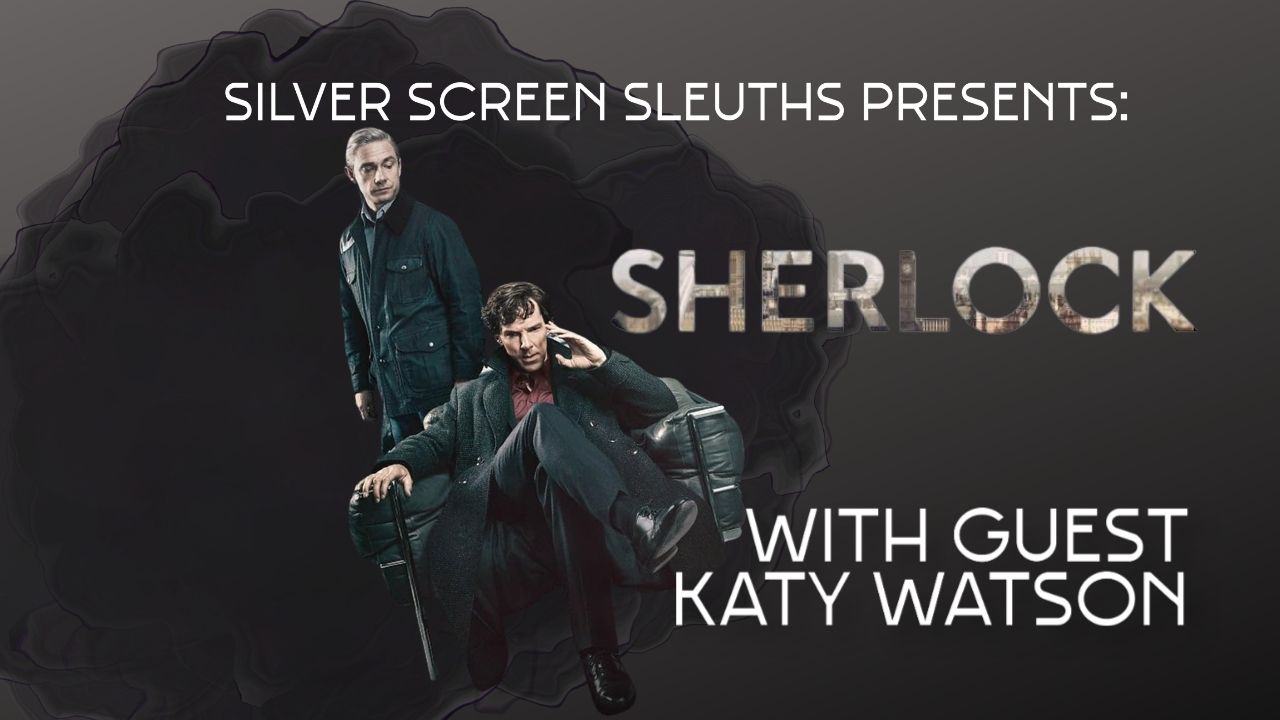
The phenomenal author Katy Watson, author of the Three Dahlias series, is here to discuss the BBC adaptation of SHERLOCK, starring Benedict Cumberbatch and Martin Freeman. The series expertly portrays the relationship between Sherlock Holmes and John Watson, and why this enduring partnership can be adapted– and will be adapted– for the rest of time.
Love Katy as much as I do?
Find her online!
On Instagram: https://www.instagram.com/katywatsonauthor/
Sign up for her newsletter: https://katywatson.co.uk/the-dahlia-diaries/
Transcript:
Emily Edwards (she/her): Greetings, gumshoes, and welcome to another episode of Silver Screen Sleuths. I am your host, Emily Edwards. I am an author. I am a podcaster. I am all around your Girl Friday here to talk with another wonderful mystery author about a mystery television show or movie. And I think literally everyone, at least in the Northern Hemisphere, has heard about what we are talking about today because on every side of the pond, it was a massive hit. With me today is author Katie Watson. How are you?
Katy
Hello, I’m very well, thank you. Thank you so much for having me.
Emily Edwards (she/her): I’m so I’m so excited to chat with you. We met via the internet a couple months ago, and I’ve been following you on Instagram and watching the evolution of your mystery series. can you tell us a little bit about it before we jump into our conversation about Sherlock?
Katy
Sure. I write the Three Dahlia’s Mysteries, which are a series of sort of cosy crime books about three actresses from three different generations who were all famous for playing the same fictional detective on screen, but who meet at a fan convention and through shenanigans end up having to solve a real life murder. And they’re really quite good at it. So they sort of keep going for… Seven books now.
Emily Edwards (she/her): my goodness, and that seven book series is really nothing to like bat your lashes at. Anybody who may not be involved in publishing anywhere may not understand how much work goes into maintaining a book for or a series for that many books. So wild congratulations.
Katy
Thank you. I’m lucky it’s an awful lot of fun to write and I’m very invested in the characters of Rosalind, Caro and Posey now so hanging out with them while I write the books is really good fun.
Emily Edwards (she/her): That’s so wonderful. And I love talking to an English writer about about such an an incredibly because here in the States, let’s be honest here, we turn on Brit Box and we have a million different investigative murder series to choose from and Gardner’s World. And we’re like, okay, this is our American concept of of British television culture.
Katy
We do do it very well.
Emily Edwards (she/her): Do what can I ask? Like, can you explain to someone who is a a naive Yankee, like what it might be about, especially the cozy or cozy adjacent, because cozy can be a little restrictive if you go by all the rules that you’re supposed to have. Like, why cozy or cozy feeling mysteries might have such like a stranglehold on on the mystery culture?
Katy
wish I knew. I think the best thing, the thing I love about cosy adjacent crime is that you have that feeling of setting the world to rights. It’s a very British thing in that you come into an established world, you mess it up by having the most appalling crime committed and then
Emily Edwards (she/her): Mm.
Katy
quite often some fairly ordinary people have to step up and put the world right again and make sure that justice is served. And that does feel like quite a British thing, especially since lot of and scones usually involved as well.
Emily Edwards (she/her): It it does. Yeah. You know, I I I love a good, like, rural mystery, and especially the ones that are being put out now in modern times, modern settings. So you don’t get as much of that like boo hiss outsider aspect that you get in a lot of sort of the older, more classic. So sorry, Dame Aggie. Sometimes she could be a little xenophobic with like, is that a Jewish fella? You know, and you’re just like, no.
Katy
Mm. That’s one of the reasons when I was writing my books I chose to set them in the modern day. That I wanted to take everything I really loved about those very classic crime novels but bring them up to date so you don’t have those moments of oh really? Quite often I hope.
Emily Edwards (she/her): yeah. Yeah. No, I I set my series in 1950. And so w frankly, I started writing them for the first during the first Trump administration. And you know, we had that whole, the 1950s, they were so wonderful, they were so great, why don’t we go back there? And I purposefully set my series in 1950 to be like, it was terrible and everyone hated it. So I totally understand the impulse to want to take genre conventions and modernize them for, you know, you can still have that wonderful thing that we get with amateur sleuths, which is the concept of community justice and the community deciding what is right and wrong and what they will allow within, you know, the people or the group of people that they know, but without a lot of the baggage that sometimes comes with the genre.
Katy
Yeah. Absolutely, absolutely. It’s one of the reasons I was excited to talk to you about Sherlock, of course, is because it does exactly that. It takes those very, very classic stories and those classic characters and situations and brings them into modern day Britain. Fairly modern, I suppose. I’m a decade or so old now, but they feel modern to me still.
Emily Edwards (she/her): They do. Yeah, no, I I apologize. I do have that horrible New Yorker aspect of being like, I’m gonna finish your sentence because I’m so excited about what you’re talking about. So please just be like, no, no, don’t do that. It’s very rude. And I understand that it’s rude to other people, so I I apologize immensely that I Okay, fantastic. Yay! this is one of my I exactly
Katy
I’m really good at doing it too, so it’s fine. Sometimes you just can’t wait for the other person to finish. You’ve got to get in there and keep things moving.
Emily Edwards (she/her): And it makes really good radio when everybody says the same thing at the same time. but that is one of the reasons why I have actually been reaching out to authors that are not people I know from down the street from where I live in Los Angeles. I want to talk to people who are from other places. I’ve already spoken to Nikessa Afia, who’s from Canada. I’ve got Meredith Hambrock, also another Canadian, coming on a little bit later. And I wanted to reach out to you because I I feel like again.
Katy
Yeah.
Emily Edwards (she/her): We especially with this Sherlock adaptation, I remember it being sort of received as a very prestige, almost HBO level drama of of high budget, huge stakes, absolutely massive, you know, the world is going to end, sort of drama in a Sherlock Holmes conceit or a Sherlock Holmes structure. And
Katy
Hmm.
Emily Edwards (she/her): I know obviously it went on for many, many seasons, even after both the lead actors really blew up and became huge movie stars and kept coming back to it. I wanted to ask if the Brits are as precious about things that are historical, sort of now almost legendary things as Americans are, because we throw fits about things all the time.
Katy
I was trying to think about this. was trying to remember when it first did and actually I just remember people being excited about it. We like stories. I have you seen, I’m sure you have seen that the BBC are making, I think it’s the BBC, are making a new Young Hercule Poirot series.
Emily Edwards (she/her): So great. I’m so excited about that!
Katy
To which my daughter said, wait, isn’t that the guy from the Horse Husband show? And I said, yes, yes.
Emily Edwards (she/her): He’s super cute. And I the other day was real like Americans were having a fit. I saw all these people stomping their feet and throwing their proverbial hands about it. And I was like, you do realize the actor’s in his 30s, right? Like he’s young compared to David Suchet, but like he’s not a baby. It’s not like it’s teenage Poirot. He’s a 33-year-old man.
Katy
You I mean I think I’ve had a lot of messages about it obviously online and people are very split between this is the coolest thing ever I can’t wait for it and I’m just so baffled what’s happening why we doing this? I think I’m somewhere in between I’m very excited to see what they do but at the same time I would have loved to have been in that meeting where they thought you know what we should do? Where did you come from?
Emily Edwards (she/her): Yeah, sexy Hercule Poirot, the least sexy character possibly ever. But people didn’t think Sherlock was sexy until Brened Kumarch. Who’s who, let me confess, I started watching this again, the 2010 episode, and I did the maths, and I realized in the first season he is 34 years old and he’s such a baby.
Katy
Until Benedict Amberbatch, indeed. He’s so young! I don’t know if this is a good time to tell this story, but in 2014 I actually met Benedict Cumberbatch, sort of, because I was appearing at the Hay Festival and my daughter, is 17 now, was four at the time and my husband had gone off to watch one of the other talks and so my daughter was with me in the green room because we were between events.
Emily Edwards (she/her): Please.
Katy
And it was one of those years where it just rained, ball festival, and hay was just slowly sinking into the mud. And we had all these sort of like wooden pathways and you’re just getting steep and So a lot of people were trying to hide out in the green room if they were allowed in, they were in there. And Benedict Cumberbatch was appearing that year. And he came in and he was doing a performance of some letters, I think.
Emily Edwards (she/her): no
Katy
bless him, you could see him, I could see him coming through and he was trying really hard to find somewhere he could sit quietly and just rehearse and just prepare and he was moving around and people kept coming to talk to him, I just, just while you’re here, I just, and he’s like, I just, I really, really need to do this, I really need to this. So he ended up at the table with me and my four year old daughter and Holly, she had her headphones on, she had a tablet, she was listening to Frozen.
Emily Edwards (she/her): Yeah.
Katy
And bless him, the quietest place in that green room for Bend It, Come Back to rehearse his performance was next to my four year old daughter singing Let It Go at the top of her voice, because at least we weren’t bothering him.
Emily Edwards (she/her): So unbelievably cute. Did she have any understanding of who he was or what he was doing there? She was like Elsa only. Like
Katy
Hahaha! Oh no, oh no. pretty much. But then this year, she and I watched the whole of Sherlock together and she was a big fan. was, you know, she didn’t like so much that I told this story at the start of every episode. But other than that…
Emily Edwards (she/her): Tell you about the time.
Katy
Remember that time, nice tall gentleman, do you remember? No.
Emily Edwards (she/her): She’s like, No, I remember the time you dragged me to a stuffy tent in the middle of this thing I didn’t want to go to where I could have been at home watching Frozen instead of on a tablet watching Frozen.
Katy
I took a seat up Julia Donaldson, she was fine.
Emily Edwards (she/her): Story so much that is so unbelievably cute. Has she ever told a friend about?
Katy
Britain’s really quite small, you bump into people all the time here.
Emily Edwards (she/her): I I you know, I really love one thing that the show does. And and I do have to admit that it it it again, as an American, it it kind of confuses me because they shot it in London and they love London and they use London as a character. And I’m like, we don’t do that.
Katy
We always laugh at it because actually they do use London and I love how they use London but so many other British shows are actually supposed to be in London are actually just filmed in Cardiff and so a lot of the time when you see London it’s Cardiff unless you see something that’s very distinctively has to be London
Emily Edwards (she/her): Good to know. Unless they’re at the Gherkin, like they’re somewhere else. Love so much that this show, again, it’s really good at showing the passage of time. And it treats London as a really wonderfully dynamic city because I know that the the original texts of Arthur Conan Doyle are are so Victorian and they’re so of the time that they’re written. And London was such an incredibly dynamic city back then, when you know, Victoria and and and my god, I’m not this dumb. Thank you. Her husband, whose name I can’t remember, Albert, decided that they weren’t going to live in a city without like sewers and things like that anymore. And I I love how much Coda Doyle that’s something that I think we mess up. Is his is is the last name hyphenated or is it just Doyle?
Katy
tell you this because I’ve got I’ve got a copy here. This is a 1892 edition for one the first American printings of The Adventures of Sherlock Holmes. It’s my husband, I have to admit I’m not a massive Conan Doyle fan. I read him and I read Sherlock for my degree when I was studying crime fiction as part of my English degree but my husband who is in fact Dr Watson.
Emily Edwards (she/her): Thank you. So neat. That’s so cool.
Katy
Certainly not Dr John Watson, but still it’s close and I like to use it. He’s a big fan so he’s loaded me up with loads of his copies before I came on here to talk to you. But it isn’t hyphenated, but it is always Conan Doyle.
Emily Edwards (she/her): So fun. Hey, good to know. Thank you. I I I always I feel like I’ve been corrected once where someone once told me like Conan was his middle name and his last name was actually Doyle. But I like, I don’t think that’s right. I’m pretty sure it’s Conan Doyle. But
Katy
It’s Conan Doyle because it’s a Conan Doyle on here. So there you go. You look right all along.
Emily Edwards (she/her): Thank you. Justification. Ha ha. I feel like Konoto might be kind of like like R. Steinbeck, where you know, you’re you’re assigned to read it because he’s this huge like historical figure. but it doesn’t really dawn on you how much he maybe did actually change modern, you know, he might have been the linchpin for modern sort of literature in in you know compared to People who came before. Like y you know, we we get the timeline of like, you know, you always have to read Hawthorne and everybody complains about reading Hawthorne. I actually really like Hawthorne. And then you get you know, Moby Dick and Melville and things like that. And then you finally get to Steinbeck and you’re like, someone who talks like a human being. Thank God.
Katy
Yeah. I mean if it’s any consolation we have to do Geoffrey Chaucer. So you’ve got to get there and do old English in your A level class.
Emily Edwards (she/her): That’s true. Exactly. No. We always got translations of Chaucer. They were like, you’re really too dumb to understand what this might be and something that’s older and really more
Katy
Honestly, we would have assigned reading of the Chaucer and you’d have to come and either translate it to the class when it was your turn or read it in the original if you hadn’t bothered.
Emily Edwards (she/her): That’s so mean. That’s so cruel. But I, you know, I was thinking when I was trying to kind of like, I was kind of just brainstorming with my husband this morning about like what was so interesting and fascinating about Sherlock and this particular modern adaptation of it. First of all, casting through the roof. I mean, like, just and then when you get Andrew Scott’s Moriarty and Mark Gaddis as
Katy
You Just perfect. I can’t watch him in anything. cannot watch Andrew Scott in anything without being creeped out anymore. It doesn’t matter what he’s playing. I can’t watch Fleabag. I can’t see him for hot briefs. I can’t do it. He’s Moriarty. He’s evil. I can’t do it.
Emily Edwards (she/her): He’s terrifying in this role. He’s genuinely terrifying. It’s I’m so glad this was such a launch pad for him. it it’s so everybody in this brings their A game. This is just an absolutely phenomenal adaptation. And then what really, really struck me was in the first episode when they are adapting Study in Scarlet, just how important technology at the time in 2010 is.
Katy
Yeah.
Emily Edwards (she/her): To how Sherlock goes through the process of solving murder. And I thought to myself, Well, the original texts were written during this huge industrial but scientific boom in the late in you know in the Victorian period. And I was just like, they get it. They get they get the soul of what Conan Doyle is trying to do here.
Katy
I think that’s what I love about them so much is how cleverly it brings all the character quirks and aspects of the plot and the setting, absolutely the setting, but the feel of the story is right into the modern day, but without having to ignore what the world is. Now you still have mobile phones, you still have all the tech and they use the tech, but the investigation never comes down solely to the tech. It’s always down to Sherlock and his deductions and his brain. And I just think it’s a really clever mix.
Emily Edwards (she/her): I I was so impressed with how well they managed to use things like again, again, because it is now an older television show. It came out 15, 16 years ago. We are shocked that you’re reminded that GPS signals on a cell phone were new and they were novel and they were expensive. And I think that, and you know, I I’m I’m in
Katy
you
Emily Edwards (she/her): Curious to hear how your daughter, who’s a teenager who’s grown up probably always with at least seeing her parents use a cell phone, how she maybe reacted, because I don’t have kids. How did she react to you know, seeing being like, What do you mean? Like it was novel that they had email on their phones? Like,
Katy
Hmm. Honestly, she’s lived through me making her watch so many other things that we had to explain pages when we did Buffy. Anything we watched that was made after she was born is a win. When we did the whole of the West Wing and she couldn’t figure out how people had got pages middled up. Yeah, it was, it’s a whole thing. She’s had a crash course in, you know, late 20s, 21st century technology. So I don’t think this one really registered so much. There were occasional bits, like you say with, yeah, no, that was kind of new or, you know, you couldn’t, you couldn’t really do that there. And then she’s like,
Emily Edwards (she/her): Ha ha ha
Katy
that’s just why why things have moved really fast
Emily Edwards (she/her): Yeah. I didn’t I I had a cell phone in college but it didn’t have a camera on it. Thank God it didn’t have a camera on it.
Katy
Yeah. God. I got my first mobile phone the year I went to university and it could just about do texts.
Emily Edwards (she/her): Exactly. And we had to pay out the no’s for them. Used to be ten cents a text message here. I couldn’t I I wonder like I it’s just such a bizarre thing to watch. And you are correct that the wonderful aspect of it is that they do leave it up to Sherlock to deduce the information that he has gleaned. And Benedict Cumberbatch.
Katy
Yeah.
Emily Edwards (she/her): I mean, I don’t know how many awards he won in England for for his portrayal. I hope he won at least something because it is I should I should probably look that up on IMDb while I’m chatting with you, but it it’s such an incredibly well-written show.
Katy
I don’t know actually, probably. I think it is, it is well written and I think there’s a lot about it. I love that the plots are so clever but in a fun way so you couldn’t necessarily solve them if you weren’t Sherlock Holmes but you don’t feel cheated when you get the reveal. You understand how it all came together and I like that. I think the last series maybe went a little bit too far with some of those but the early ones definitely. I don’t think, even having rewatched it, I don’t think that actually the writing and the plots of what make the show at all.
Emily Edwards (she/her): Yeah.
Katy
I just don’t think they were clever, they were good. The cinematography is lovely and it’s really quite clever and there’s shots of London and the rest it. But I don’t think that’s why people tuned in. They tuned in because of Sherlock and Watson, because of the characters, because of the found family, because of the people they brought around them, because of the way they changed each other, how they came to appreciate each other. It was that friendship and how it grew. And I don’t think if you’d had anybody else in those two main roles, you would have had the same chemistry that brought those scripts to life.
Emily Edwards (she/her): Yeah, they were clever. No, I th I do agree with you. Even down to Lestrade and Mrs. Hudson, they’re they’re so
Katy
Mm-hmm. And Molly Hooper and just, yeah. Yeah.
Emily Edwards (she/her): Yeah, I you know, I was reading a little bit and Molly wasn’t supposed to show up in that many episodes, but she just is so the pathos you feel for her while struggling.
Katy
She adds so much depth to it, doesn’t she? And I think that’s what you need. If you just have a character like Sherlock, it’s almost unwatchable. If you put John Watson in there, you have a translator and that works really well. But it’s not until you bring other people around and you go, well, these normal, nice people who I actually connect with like this.
Emily Edwards (she/her): Mm-hmm.
Katy
really odd man, there’s something more there. That’s how I think we connect and how we learn to see him through their eyes. I think that makes a huge difference. And then I think the sibling relationship, of course, is also between Sherlock and Mycroft. I think that’s incredibly well done and very clever and gives you that other side that you can suddenly see a more rounded picture of Sherlock and how he came to be the way he is.
Emily Edwards (she/her): Yeah. Yeah. I agree because whenever he’s in a scene and you have Benedict and Mark kind of playing off of each other and trying to just subtly outdo each other with the snippiness and the the the sociopathy that they both feel. It and the first moment of banter between them in the in the first sort of extra long episode that we get.
Katy
Thank
Emily Edwards (she/her): Is is so you see wa John Watson who’s standing there like a deer in headlights, just going, like, what am I witnessing between two human beings I never could have imagined tread this earth because they’re both so bizarre and so weird. And then when it finally dawns on him that they’re siblings, you can see the sort of the color drain out of his face, where he’s like, my god, there’s more of them, and some of them are worse.
Katy
I think John’s reaction to Sherlock’s first big show of incredible deduction where he says, you know, that was amazing. And I think that’s the moment Sherlock, you can see him react to that and you think nobody normally reacts that way, do they? They normally react with, that’s really weird. And you can just see how this is a starting point, how this is something new for both of them. And I love that.
Emily Edwards (she/her): Mm-hmm. Yes, exactly. I love that. I and I also do greatly appreciate that they did not balk at the opportunity to make textually appropriate and accurate that John was in a war and that John is a soldier. I feel like, you know, when you watch the David Suchet Poirot too, whereas he’s got Hastings with him, but they never mention really, they never go into details of why he’s a colonel, how he’s a colonel. in what what his career actually involved.
Katy
what that has meant for his past, yeah, and how that has shaped him.
Emily Edwards (she/her): And they don’t shy away from that with with John Watson, which I appreciate immensely, because they could have just left it out. They could have ignored the fact that he was an army doctor.
Katy
Yeah, yeah, I’m glad that they didn’t. I think it brings an awful lot, a lot to it.
Emily Edwards (she/her): And and and and the fact that the the the war that they were fighting at the time was our crap in Afghanistan that we ruped you all into. And and all of the politics that went with that. and and I it would have been perfectly understandable to ignore it. And it’s I think it’s very brave, at least historically, to acknowledge that, you know, it it was not. it it it was an incredibly unpopular war that people went to, got injured in and their lives ruined in order to participate in it and and just extremely brave choices that are made on television in Britain that I don’t think Americans would necessarily do.
Katy
because they don’t feel the need to either glorify his service or make it a big political message either. It’s just something that has formed him and you can, they don’t need to do the messaging. You can see how it has shaped him and you can see it in the character and you can see who he has to have been to go and take part in that. He has to have been incredibly brave. He has to have been incredibly willing to sacrifice and to be all these incredible virtuous things. But at the same time, you can see that it has changed him and it has damaged him.
Emily Edwards (she/her): Mm-hmm.
Katy
and it has affected his life forever. And that’s an incredibly sad thing for him. And you can see all that in the character without it having to be a message that they are giving us. It’s just part of it.
Emily Edwards (she/her): Mm-hmm. Yeah, and and and I do also appreciate the fact that they don’t glance away from the fact that John has difficulty paying his bills. He is his army pension is not substantial. It’s not like he comes back as an injured war hero and is suddenly dripping in cash and can throw it around and afford his own lavish apartment in London, which no one can afford.
Katy
Yo, we’re going be forced to live in London!
Emily Edwards (she/her): I I I think I don’t know if this is textually based, but the line that Mrs. Hudson is giving Sherlock the the apartment for below market value because he insured her husband was put to death in Florida.
Katy
I love that! I love that’s the explanation for how they managed to have this fantastic apartment in Baker Street when no one could afford to live.
Emily Edwards (she/her): And she just does all these wonderful things. And Mrs. I really, really just love Mrs. Hudson throughout this entire television show. She’s such an incredible character. She she again in the text is kind of, you know, she’s treated like the landlady. But I think in this, again, because the casting is so dynamite, she you can’t let her fall into the background. She
Katy
Thank you.
Emily Edwards (she/her): Ші команд attention against these two actor, these two heavy weight actors.
Katy
Absolutely and yeah I think that the whole community, whole sort of found family of the show adds so much depth to those two main characters that I think you don’t get if you just put the focus on on the John and Sherlock.
Emily Edwards (she/her): You know, I I I have read every single Sherlock book and short story. I enjoyed them immensely. I do think a lot of people got frustrated for a little while with Conan Doyle because he does do a lot of that, but I knew secret information that you could never have possibly known. And I think for people who are very who come to mystery. Because they are logical people. And I write mystery because I connect emotionally with the idea, similar to what you were discussing, of community, of banding together, of of fixing things that were knocked over and setting everything back to rights. I also connect with that. And obviously in America, we’ve had a real come to Jesus about policing and things along those lines.
Katy
Yes.
Emily Edwards (she/her): and so I think that’s why a lot of people do come to mystery and to crime fiction. But I I also am very well aware that a lot of people whom whose brains maybe work like Sherlock Holmes come to mystery fiction because they want to solve the puzzle and they want to show that they are perhaps as smart or smarter than the writer. They want to get to the answer before you reveal it in the book. those sorts of folks actually surprisingly don’t like Sherlock books.
Katy
I can absolutely see why, because it doesn’t feel fair. It’s not the Fair Play rule that we have in so much of the detective fiction. Not every clue is there on the page for you when you need it. And I think there is an element of that in the show as well, that you couldn’t necessarily solve a lot of these mysteries on your own just by watching. There’s information that’s kept back and there’s things that…
Emily Edwards (she/her): Mm-hmm.
Katy
only Sherlock could possibly know. And there are occasional leaps of logic where you go, I’m not 100 % sure about that one. I don’t think it matters quite so much in the TV show though, because I think TV feels slightly more passive in a way that you are being entertained, whereas when you’re reading, you’re reading into something. So I think it doesn’t bother me so much in TV as it might do on the page, perhaps.
Emily Edwards (she/her): Yeah, I agree. I wonder how much of that too is it it started to fly off the handle a little bit in the in the later seasons or this later series. and i a I did not really quite realize that those aired as late as they did in, you know, twenty seventeen. Because again, until the advent of streaming here you know, American television was every September you started a new series and they ended in May and then they didn’t disappear.
Katy
Thanks.
Emily Edwards (she/her): Perhaps for the same length of time as they frequently do in Britain.
Katy
Yeah. It’s a bit more ad hoc over here. think at the time, Steve Muppet, they were also working on Doctor Who and so everybody was cross because nobody was getting the show they wanted. It was like, why have we got to wait till then for a new Sherlock? And then why have we also got to wait till then for a new Doctor Who?
Emily Edwards (she/her): Right. That poor man, he was earning tons of money but shot himself right in the foot.
Katy
Everybody was close. Everybody was close to them.
Emily Edwards (she/her): But I wonder how much of the 2017 sort of aspect of not all of the clues are presented on screen. It’s not fair play. Might have been because at that point people were more inclined to be on their phones or on their on their their computers and more listening to television. I know I have a number of friends who are television writers, and now you are instructed.
Katy
Mm.
Emily Edwards (she/her): To write as though they are not looking at the television. They’re looking at the phones. So it’s almost more like radio plays. And
Katy
Yeah, I’ve heard that as well. You can see it, can’t you, when you’re watching TV now? You can see the lines they’ve put in because they don’t expect you to actually be watching the screen right now.
Emily Edwards (she/her): That must be brutal on mystery writers on people who write f mystery for television. I could not imagine.
Katy
Yeah, yeah, I think it must be really, really difficult because what’s the point of it if you can’t hide things in plain sight?
Emily Edwards (she/her): Exactly. You know, I I one of the things that I have been trying to bring up with discussing, because we’re talking we’re mystery authors, we write mystery novels, we write mystery books, and books are, as much as we don’t like to admit it, fundamentally different experiences with story and narrative than, you know, anything that appears on the screen. You can take my book and please do for a hefty fee and put it on the screen, but something is going to be lost in the translation. And And I think a I and I wonder what you feel might have been removed from the experience of reading a Sherlock novel when seeing a Sherlock adaptation on screen.
Katy
That’s a really good question. I think… I’m not sure. guess when you’re reading with any mystery, when you are reading it, you have to look harder for what isn’t said on the pages. Someone is hiding things. But at the same time, you have more of the information there. On the screen, it can be a flashing image that’s just gone. And you might not have seen it or you might and things like that. I think with the TV, it’s all that much faster. you don’t have time to go back and look over that page and you don’t, know, it’s the slower experience perhaps of trying to solve the mystery yourself. I don’t feel you do that quite so comprehensively with TV. I mean, I’ll admit when I’m watching Midsummer Birders, I’m guessing from the start, I’m not allowed to talk during TV shows anymore. My husband, Dr. Watson says, no, you’re right too often, you’re not allowed to do it. But I think sometimes with TV, it’s easier to see the set up.
Emily Edwards (she/her): Mm-hmm. Mm-hmm. Mm.
Katy
you can see a little bit more sometimes where things are going because you can’t hide things in the same way as you can on the page. But at the same time, sometimes it can be easier on television because you can show something without referencing it. And if you’re not paying full attention and you are on your phone, you’re going to miss it. But it was there, it was fair play. You could have seen it if you were paying proper attention. Yeah.
Emily Edwards (she/her): Yeah, you just weren’t playing. You weren’t playing the game. I, you know, I think one of the most again, we keep coming back to casting on this, and I think one of the most interesting aspects of translating Sherlock or really any, especially older books, is that Sherlock wasn’t necessarily supposed to be good looking. And we have, you know, unfortunately, you can’t put normal looking folk on television.
Katy
No, although at least I think when they chose Benedict Cumberbatch, obviously he’s an incredibly good looking guy, of course he is, but he’s unusually looking as well. He’s not… They didn’t put somebody up there who is conventionally Hollywood gorgeous in that way. He became more attractive to people after Sherlock, I think, because the part was so compelling. It’s not that Sherlock is necessarily handsome and gorgeous.
Emily Edwards (she/her): Yes. Yes. Right.
Katy
it’s that he is just incredibly compelling.
Emily Edwards (she/her): He is so compelling. And I think one of the things that I find very shocking about television shows that are that are frequently made now is that you know it’s one of the things that we’re talking about with the pit, which is sort of the ER rehash that they’re doing on HBO. It’s got Noah Wiley again. And everybody on the show is competent. And you watch this television show and the doctors
Katy
Mm. Mm.
Emily Edwards (she/her): You know, they may not know exactly what the diagnosis is, but gosh darn it, they’re gonna find out and they’re gonna save someone’s life and they’re gonna do everything they can to save someone’s life. And if they can’t save their life in the ER, then my gosh, they’re actually they’re devastated and rightfully so about it. And Sherlock really drove home for me again just how much I have longed for competency.
Katy
Competence is one of the most attractive traits a person can have. Yeah, massively, absolutely so. Yeah.
Emily Edwards (she/her): Isn’t it? And and I think it’s really shocking that again you have everybody okay, there’s a female police officer in the first episode who never comes back, and she’s just a nasty, nasty woman. But and I hate using that phrase because of how loaded it is now, but she she’s not really very well-written. She’s just very s no, she’s not very nice, and she’s a little snippy, and she’s she wants to undercut everybody. But until and she’s only in one, you know, interstitial of the show. And everybody else then after the fact.
Katy
It’s not very nice, is she? Yeah.
Emily Edwards (she/her): They you have the usual rub of a private investigator showing up the cops, and that always makes the cops feel bad. And you understand. And but at the same time, at least in this, they do a wonderful job of Lestrade and the other detective inspectors understanding that Sherlock is more competent at doing things than they are, and they appreciate the help.
Katy
Yeah, that he brings something different, that they are very good and competent at their own jobs. It’s not that they are incompetent. It’s that Sherlock has something different. And I think that’s what makes it work. It isn’t a competition in quite the same way all the way through. He’s friends with the Strad, you know, that that works well as a partnership that Sherlock’s providing something he wouldn’t otherwise have access to.
Emily Edwards (she/her): Mm-hmm. I think one thing that American detective fiction did, and especially in its heyday, in the noir sort of post-World War I, post-World War II, you know, that sort of modernist era of of detective fiction, is they wanted because the American writers, you’ve got Raymond Chandler, you’ve got Jashel Hammett, and the rest, you know, kind of like Gilligan’s Island, who are going through it, they’re so mad at authority because of what they’ve already lived through that they need to.
Katy
Yeah.
Emily Edwards (she/her): Tar and feather the police just in every instance that you get. you know, Philip Marlowe is notorious for every single time he shows up. Some cop is right behind him to whack him in the head with something, beat him up, knock out a couple of teeth, bloody the nose, throw him in jail. And I mean, again, as an American, I get it. Like
Katy
Yeah. The impulse is not an unfamiliar one.
Emily Edwards (she/her): Exactly. the d d no most of your lay Americans, not big on cops. Imagine that. But the but our detective fiction is so thoroughly rooted in the antagonism to police officers that I think sometimes we as an American audience misunderstand the friendliness that Sherlock might have with Lestrade. and that they do c sort of consider themselves contemporaries or, you know, like
Katy
Mm.
Emily Edwards (she/her): opening up a book and be seeing two pages next to one another as opposed to antagonists and needing to, you know, completely interfere with the other one’s work.
Katy
Yeah, I I absolutely think Lestrade is frustrated by Sherlock all the time, but that doesn’t mean he doesn’t also appreciate what he’s capable of. And I think that that’s fun. I like that. My brother-in-law is actually a policeman. In fact, he’s a detective inspector, which is very useful when I’m writing and I can, I I can think. But it does mean I’m very careful about how I use the police in my books.
Emily Edwards (she/her): Yeah. Yeah. y I’m sorry. That that totally makes sense. I’m less careful. I I fully admit that when discussing saying and say I wrote a 1950s New York City crime series, let me just tell you, my family was the people they were going after in New York City in the 1950s.
Katy
You
Emily Edwards (she/her): I have records
Katy
you
Emily Edwards (she/her): of all of the time my grandfather, great grandfather, and various uncles did it Sing Sing. Like I have record So I’m like, listen, husband, you know what family you married into.
Katy
Wouldn’t be that cool though. You
Emily Edwards (she/her): I do have to admit that British mysteries, they seem so orderly to me. And and like, especially in the this Victorian era, when again, Conan Doyle was not purposefully antagonizing the Victorian culture. He liked it. there are certainly writers who were like, wait a second, we can’t talk about sex, we can’t talk about bodies, we can’t talk about this, we can’t talk about that.
Katy
Hmm.
Emily Edwards (she/her): And Conan Doyle was not as sort of he was a medical man, so he had more comfort with it, but he wasn’t looking to sort of like overthrow the strictures of of early nineteen you know, eight late eighteen hundreds, early nineteen hundreds. Yeah.
Katy
No, he’s very much part of the culture he’s writing about rather than trying to make a statement about it, isn’t he? It’s just within it.
Emily Edwards (she/her): Yes. Yes. and and I find that very charming. But I do w I do sometimes wonder I just wanna be like ’cause I’m a rabble browser, I always just wanna be like, yeah, but sometimes don’t you wanna s like buck some stuff up?
Katy
You
Emily Edwards (she/her): Separated by the Atlantic Ocean and respect for authority.
Katy
Yeah, I think we probably do tend to be a little bit more orderly. You’re right. We to work within the constraints. Yeah, not all of us. yeah, that’s different.
Emily Edwards (she/her): Yeah. Until there’s a soccer game. Like that’s different. I do have to admit, I know Scotland is a different country. but I do absolutely love how much we have been tickled by having the Scots in Boston for the World Cup the last like week or so. We are we’re
Katy
You I love to drink it dry. That’s very on-brand.
Emily Edwards (she/her): Okay, it’s so much fun. I can’t even tell you. LA’s been getting some like really weird matches, But I was like, what brilliant person sent the Scots to Boston where they drank? And I’m not kidding you, a barkeeper said that the Scots people. In pr in Boston, over the course of one day, drank three times as much beer as they sell on Saint Patrick’s Day.
Katy
I could, yeah, I can see it, yeah.
Emily Edwards (she/her): Clean all their garbage in the commons and they put it in bags and But apparently all the Scots people bagged up their trash and left it for the like the the keepers to keep up. And I’m just like, yeah. They can come back.
Katy
Come back, we’re good for business.
Emily Edwards (she/her): I I bring up Edinburgh n and the Scots people, not just because I don’t know the difference between England and Scotland, but Conan Doyle was Scottish. He w he or he went to school in Edinburgh, correct? Like that’s where he got his medical degree, I believe. And and it and it it’s it’s funny because I I’ve only been to Edinburgh once. Absolutely loved it, would move there tomorrow if I had enough money.
Katy
Okay. Yes. It’s beautiful city.
Emily Edwards (she/her): It’s so gorgeous. It’s again one of those things that messes with your concept of time as an American when you go to like the new part of the city and it was built before Boston was. And you just I have no concept of time once I’m there, and it’s absolutely gorgeous. But I love how much of the city is respectful of their their literary history, their UNESCO literary heritage site. And part of that includes Conan Doyle, who
Katy
Yeah
Emily Edwards (she/her): I know I compared him to Steinbeck earlier in the episode, but he I feel like he’s so much more of a he’s considered more of a pop author here than perhaps a literary like author. And I gather that that’s not how the UK at large considers him.
Katy
Really? You No, it’s a funny one because I think everybody obviously in the UK knows Sherlock Holmes, would identify him in a line up if you had to. I’m not sure how many have read him. He’s not on school syllabuses. He’s not, you you wouldn’t study Conan Doyle in school. You would only ever read him by choice. People are more likely to have seen adaptations on telly than they are to have read the actual books.
Emily Edwards (she/her): Gotcha.
Katy
mean, obviously lots of people have, but I wouldn’t say it’s sort of an automatic one. It’s not something like everybody’s had to do some Shakespeare at school. Everyone’s had to do, you know, probably had to do some Jane Austen maybe or had to do, I wouldn’t say Conan Doyle would fall into the same realm.
Emily Edwards (she/her): Yeah. Mm-hmm. That’s so interesting to me. I find that fascinating. Again, it’s one of the ways that people treat genre literature, which I’ll I’ll never understand, especially something like crime fiction and mystery fiction, where we have to be so in tuned with human emotion and human impulse and human psychology that I feel not to denigrate any other genre, that crime fiction truly e. truly does not get the respect it deserves when you’re talking about the author’s understanding of humanity at large.
Katy
Absolutely. I think that is what makes crime fiction interesting to me is it’s not the clever way the crime was committed or, you know, any sort of amazing deductions. As much as I enjoy watching Sherlock do that, that’s not why I’m watching the show and it’s not why I read crime fiction. I’m reading for the why. I want to know why someone…
Emily Edwards (she/her): Mm-hmm.
Katy
I want to get into the weeds of the human psyche. want to know what made that person feel that they had no other option than to take a life. I want to know how you can find that out about a person. I want to know everybody’s secrets so I can figure out which one the best one is. And that’s what I want. I want that connection to people in all their messiness, know, all their absolute glorious horribleness quite often. know, all the parts that…
Emily Edwards (she/her): Mm.
Katy
we try to keep hidden when we’re out around anything. I want to see under the surface. I want to see all of that. And that’s what make crime fiction so engaging to me. I love the glamorous settings we get in Agatha Christie’s and I love the over the top characters as well. The ones that you think that’s, you you know who they are from the moment they walk on the page, even though you’ve never met anybody quite like that. And I love more than anything, the detectives and the found families and the
Emily Edwards (she/her): Mm.
Katy
the sidekicks and the people coming together to solve. But yeah, underneath it all, it’s never about who did something for me. It’s all about why.
Emily Edwards (she/her): Yeah, you know, I love that you’ve brought up found families most quite frequently in this. And I have used the same phrase to describe again my character who lives at a board an all-women’s boarding house in 1950. And she doesn’t really talk to her parents, but she lives, you know, amongst a bunch of women and she brings cases home and over the dinning dinner table. You know, the the landlady who’s from Ukraine, you know, she’s she’s feeding them because, you know, that’s what Eastern Europeans do in order to think you need to have a full stomach. And she’s like, all right, girls, we’re gonna help, you know, Viv figure this out. And what’s interesting to me is that I’ve had some pushback in describing that as found family because that is a very queer or LGBTQ-coded thing.
Katy
what you do.
Emily Edwards (she/her): amongst at least modern American readers that I I I’ve interacted with. And, you know, and I understand the impulse to say that, you know, or the the ownership feeling of like once you’ve been ostracized from your birth family of needing to find community and found family, but it is an integral part of mystery fiction. and and can you go into a little bit of how you use it?
Katy
Okay. It is.
Emily Edwards (she/her): In addition to the dahlias how you use it in your books.
Katy
I mean I will preface this by saying my 17 year old daughter uses it so I think I’m okay. absolutely understand that too and I haven’t heard that before and I can absolutely can see that. I think with my dahlias I do describe it as a family because that is how they think of themselves. I think when they meet
Emily Edwards (she/her): Okay. No, I think you’re good. No, I I I th I think no, I understand why it is I understand why it’s precious to people, but yeah.
Katy
in the first book we have Rosalind King who is in her 60s, she’s a national treasure, she’s been in everything, she knows everybody, calls everyone Dahlia, that kind of you know glamorous elder actress who starred in the original movies back in the 1980s, kickstarted her career. And then you have Caro Hooper who played the role of Dahlia through every single TV
Emily Edwards (she/her): Mm-hmm.
Katy
episode they did ridiculous number of series you know she’s the David Suchet she’s the one everybody thinks of when they think of Dahlia Lively she’s that one but she’s never done anything else except that and they cancelled the show when she was just about to turn 40 and she’s now in a position where she doesn’t necessarily have anything else and she is also famous for having a rather contentious divorce with her husband who
Emily Edwards (she/her): Yes.
Katy
She set his tie on fire while he was still wearing it, but it’s okay because now she’s married to the wonderful Annie, who is very wonderful for her. And they have this lovely, lovely marriage that my daughter particularly enjoys. And then the youngest of all is Posey Starling, who is an ex child star who was out in Hollywood, but a British originally, who went off the rails when her parents embezzled all of the money she’d ever made. And she’s obviously ostracized from her parents and she
Emily Edwards (she/her): Ha ha. Love that. no.
Katy
is now fresh out of the same wilderness and also rehab and about to star in the new movies that they’re, the new reboot movies they’re about to make. So the reason it feels like a fan-famine to me is these three women have nothing in common except this role they have played. There is literally no reason that would have brought these three people together if they hadn’t all just happened to play this one role as a detective. And when they meet, they don’t like each other. They’re not friends. They’re not automatically going to become close. but they put the effort in so they do. Solving murders brings them closer together and then in book two, it’s still not totally bedded in, but when Rosalind, there’s an accident on set and they’re not sure if it was a murder attempt and they phone Karen, she’s right there. She comes straight out and suddenly they accept that there is something and it builds and builds and builds.
Emily Edwards (she/her): Right. Yeah. Mm-hmm.
Katy
And that’s one of my favourite things about writing the series is writing that relationship between these three women. And it’s the thing that a of my readers say they keep coming back for. They love the puzzles, they love the mysteries, they love the settings, love all those things, but they come back for the women. And, you know, they add people in from time to time, you new people come in, but it’s the core of the three of them. And they’ve chosen that. They’ve made that themselves. And that’s the family they’ve chosen. They spend Christmas together. They do all the things you would do with a family.
Emily Edwards (she/her): Yes. Mm-hmm.
Katy
It’s them now. And that’s so, yeah, I don’t know how else I would describe it.
Emily Edwards (she/her): I love I love that. No, and and I’m glad you went into detail about how it manifests in your in your series, because I think one things that that we kind of forget, you know, it especially in the first episode, and whenever you read about someone new being introduced to Sherlock, to Sherlock Holmes, it’s always how, he shows signs of sociopathy or he doesn’t interact with people or he maybe doesn’t understand emotion, but he is never severed from Watson. It is always Sherlock Holmes and Watson. And I think it’s so important to understand both how it’s it appears in the text and how it’s always translated to screen. No matter how it’s translated to screen, you need to have a Watson. And I think it’s so it’s so odd to try to sever the emotion from crime fiction. You know, you have to be. Devastated when you find a dead body, you have to understand peril, you have to understand the consequences of actions.
Katy
Yeah, again, I just don’t think Sherlock would work as a character if you didn’t have Watson there to translate him, to humanise him, to bring all those things home that Sherlock can’t quite connect to. Yeah, it’s a partnership and they both provide something that the other doesn’t have.
Emily Edwards (she/her): Mm-hmm. Mm-hmm. I I I I I’m debating whether or not to jump into another question because I we’re coming up on about an hour and then I I appreciate you always you giving me your time. But right before I head, I appreciate so much that in this particular adaptation to screen, they don’t shy away from the fact that two men in a close relationship are often read as queer, but they’re not. Hostile any time they’re ever mistaken for a couple.
Katy
No, I like that a lot. And I think if it had been made five years earlier, they would have been. I think it’s one of those things that you would it would have been a funny, funny joke that they would have had to make a big deal about say, no, that’s not. And I like you don’t have to I think it would have ruined it if they did. And I think it’s important because it almost doesn’t matter. When you see
Emily Edwards (she/her): Mm-hmm. Yeah. Mm-hmm.
Katy
Sherlock giving his speech, his best man’s speech at John’s wedding. When you see John’s reaction to that, it doesn’t matter what sort of love this is, it doesn’t matter if it’s romantic or not. These are the most important people in the world to each other. They have reached that point in their friendship by then that they complete each other, that you have been through terrible things, they lied and suffered and come out the other side and they still
Emily Edwards (she/her): Mm-hmm.
Katy
maybe will never fully understand each other because they are to a certain degree unknowable. They don’t have what it would take. Sherlock will never be able to fully understand John Watson because he doesn’t have what he needs to be able to do that and vice versa because Sherlock is a little bit unknowable to all of us and it doesn’t matter. They love each other so deeply and so strongly that for me watching it, it doesn’t matter to me what form that love takes. I just love that they have that.
Emily Edwards (she/her): Mm-hmm. Mm-hmm. Can’t thank you enough for choosing this text and and chatting about it with me. How can everybody who’s listening keep in touch with you and your work and your series?
Katy
I would love it if they did. Probably the best place to find me is on Instagram. I’m Katie Watson, author or on my website, Katie Watson dot co dot UK, where you can sign up for my Dahlia Diaries newsletter, which will give you all the latest things and also the opening chapters of my new book, Death on a Live EC, which is out in July, the next month.
Emily Edwards (she/her): Ha ha. Congratulations.
Katy
So yeah, I would love to hear from anybody who is listening to this. If they want to carry on the conversation, just drop me a message.
Emily Edwards (she/her): Wonderful.
Leave a Reply